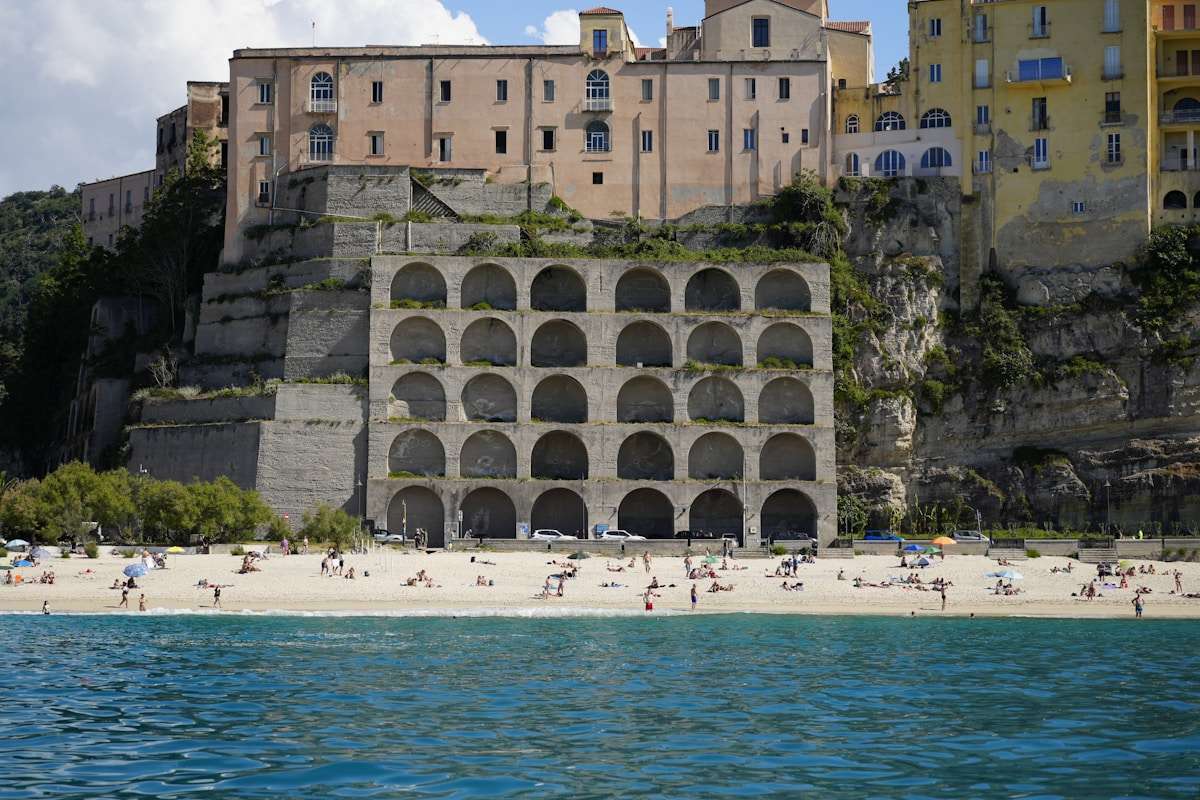
Tropea is one of southern Italy’s most photographed towns — a compact medieval centre balanced on a sandstone cliff above a Tyrrhenian beach of improbable blue-white clarity, with the Church of Santa Maria dell’Isola perched on its own rocky promontory at the north end. The fame is justified. What distinguishes Tropea from the Amalfi Coast is scale: this is a small, manageable Calabrian town rather than a tourist infrastructure. The beach is excellent, the red onions are genuinely extraordinary, and the centro storico has good restaurants at sensible prices. Accommodation is almost entirely in the clifftop town and the slopes below it.
Search Tropea hotels on Booking.com to compare prices and check availability across all areas in this guide.
Centro Storico (Clifftop Town)
The historic centre — Corso Vittorio Emanuele III and the streets running off it — is where you want to be. This narrow pedestrianised spine runs the length of the sandstone cliff, with views south over the beach from the balustrade and north towards Santa Maria dell’Isola. Everything of note is here: the Cathedral, the Norman architecture, the best restaurants, the ceramics shops, and the steps down to the beach.
Pros: The most atmospheric option in any season. Walking distance to everything. Perfect for the evening passeggiata. Sea breezes make the heat more bearable than the beach level in August. The Church of Santa Maria dell’Isola viewpoint is an easy walk from any hotel in the centre.
Cons: Very busy in peak season — the narrow streets become genuinely congested in August. Most hotels do not have parking; car drivers need to leave vehicles in the cliff-top car parks and walk. Some guesthouses require stairs — not ideal for heavy luggage.
Budget (€60–100/night): Small B&Bs and guesthouses tucked into the lanes off Corso Vittorio Emanuele. The B&B La Cattedrale (near the Cathedral): simple rooms in a historic building, good location, family-run; doubles from approximately €70/night as of 2026. The Tropea Boutique Hotel is a well-reviewed boutique option in the centro storico with comfortable modern rooms and a strong location; doubles from approximately €80–100/night as of 2026. Several apartment-style rentals in the historic streets offer excellent value for groups or longer stays at approximately €65–85/night.
Mid-range (€110–200/night): The Hotel Cala di Volpe (Largo Galluppi): a boutique hotel on the clifftop with sea-view terrace and a small pool; doubles from approximately €140/night as of 2026 in shoulder season. The Hotel Il Barone (Via Roma): a converted historic palazzo with individually designed rooms and period details; doubles from approximately €130/night. Both book out months in advance for August — early reservation essential.
Luxury (€220–380/night): Tropea has a handful of high-end boutique properties in restored palazzi with private terraces and sea views. These are small (5–12 rooms), book out for peak season almost a year ahead, and command significant premiums in August. Expect approximately €250–380/night for the best rooms in peak season as of 2026; the same rooms fall to approximately €180–220 in June and September.
Beach Level and Lower Slopes
The main beach — Spiaggia di Tropea — runs for about 1.5 kilometres below the clifftop town. The beach hotels here are more resort-focused: pools, direct beach access, organised sun loungers and umbrellas. Some properties combine a beach position with shuttle or funicular access to the town above.
Pros: Direct beach access — step off the terrace and onto the sand. Ideal for families or anyone whose primary goal is swimming and sunbathing. Some hotels have large pools and children’s facilities not available in the clifftop B&Bs.
Cons: Less atmospheric in the evenings — the restaurants and nightlife are in the clifftop town, requiring the steep staircase or a shuttle to access. Beach hotels tend to be larger and more standardised than the boutique properties above.
Mid-range (€100–180/night): The Villaggio Baia dell’Est and similar beach resorts along the Tropea coast offer all-inclusive or half-board options popular with Italian families; doubles from approximately €110–150/night in July, more in August as of 2026. For independent travellers, look for smaller guesthouses on the lower slopes where you’re within a 5-minute walk of both the beach and the steps back up to town.
Capo Vaticano (10 km South)
Capo Vaticano is a headland 10 kilometres south of Tropea with some of the best beaches on the Calabrian coast — particularly Grotticelle beach and Riaci. Several small hotels and resorts operate here, away from the Tropea crowds.
Pros: Better beaches with more space, particularly in peak season. Quieter overall. Some exceptional clifftop views and sea caves accessible by kayak or boat. More peaceful atmosphere than central Tropea in August.
Cons: A car is effectively required — there’s no practical public transport between Capo Vaticano and Tropea town. You give up the atmospheric evening in the centro storico. Limited restaurant options compared to Tropea itself.
Mid-range (€110–190/night): Small hotels and agriturismi near the beaches. The Hotel Rya Resort and similar properties offer pool, sea views, and direct beach paths; doubles from approximately €130/night in June as of 2026. The Sentido Michelizia Tropea Resort is a larger four-star resort option with pool, beach access, and sea views on the Tropea coast; doubles from approximately €150/night in shoulder season. Peak August prices are significantly higher across all Capo Vaticano properties.
Plan your trip:
- Browse tours and boat trips from Tropea
- Book an airport or station transfer
- Get travel insurance before you book
- Pick up an eSIM for Italy
- Search hotels in Tropea on Booking.com
Booking and practical tips
- Book far ahead for August. Tropea is one of Italy’s most popular beach destinations with Italian tourists, and good accommodation fills up for August by early spring. If you’re set on August, book 3–4 months ahead minimum. For July, 6–8 weeks ahead. For June and September, 2–4 weeks is usually sufficient.
- Getting to Tropea. The nearest airport is Lamezia Terme (SUF), approximately 60 kilometres away — about 1 hour by train or 50 minutes by car. Tropea has its own train station on the Reggio Calabria–Lamezia line, with regular connections; journey time from Lamezia is approximately 50–70 minutes. From Reggio Calabria (140 km), trains run roughly hourly.
- Car or no car. Within Tropea itself, you do not need a car — the town is pedestrianised. For exploring Capo Vaticano and the surrounding coast, a car is useful. Parking in the town centre costs approximately €3–5/hour in season at the clifftop car parks.
- The red onion market. Tropea’s famous red onions are available across the town from May to September — in shops, at the market stalls, and in most restaurants. They’re significantly sweeter than ordinary onions and are used extensively in local cooking. Worth taking home in dried form.
- City tax in Tropea is approximately €1–2/night per person — payable at the property.
- Beach access. The main Tropea beach has a mix of free sections (spiaggia libera) and paid sections with sun loungers and umbrellas (approximately €15–20 for two loungers and an umbrella per day as of 2026). The free sections are limited in July and August — arrive early.
For the full Tropea guide: our Tropea city hub covers the Santa Maria dell’Isola church, the best beach spots, and day trips along the Calabrian coast.
Ready to Plan Your Trip?
- Southern Italy Itinerary - Naples, Calabria, and Sicily in sequence
- 3 Weeks in Italy - the north-to-south grand tour including the deep south
- 1 Week in Italy - a first-time overview