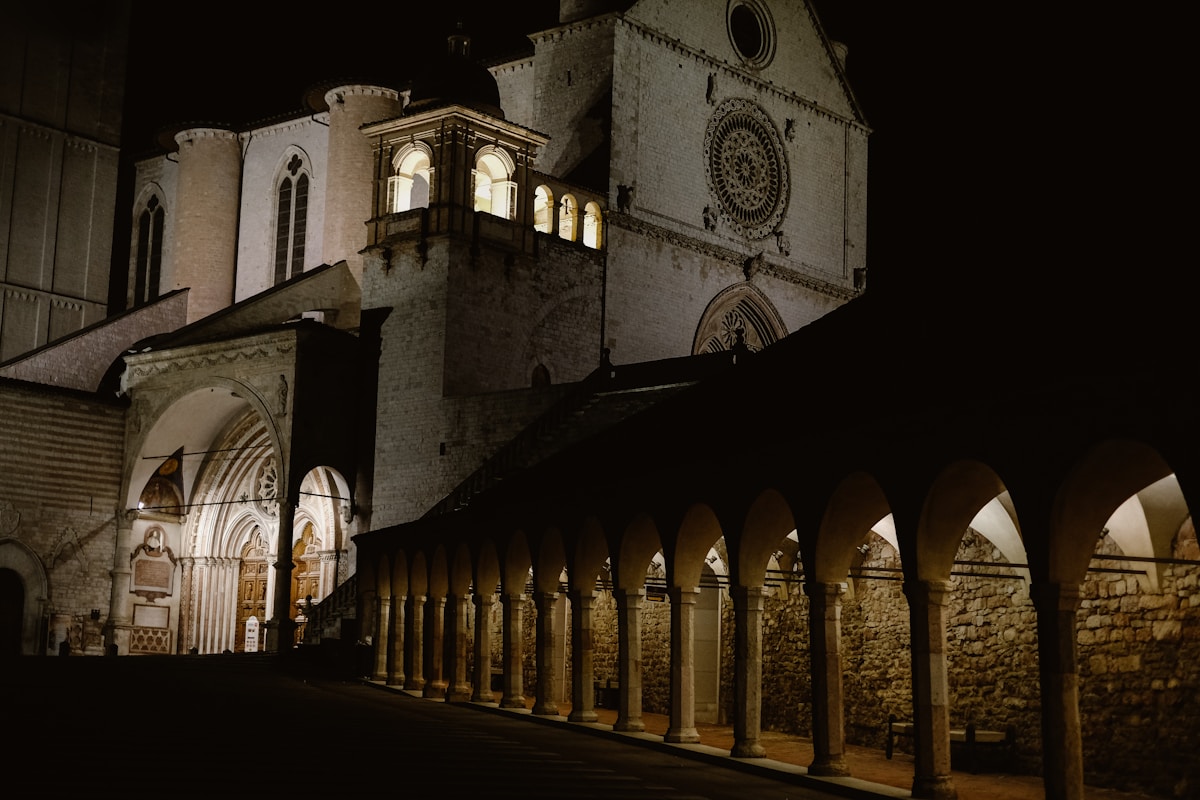
Assisi is one of Italy’s most immediately legible hilltop cities — the pink Subasio limestone buildings rising above the Umbrian plain, the double-tiered Basilica of San Francesco visible for miles, and the narrow medieval lanes that haven’t changed structurally since the 13th century when Francis of Assisi made them famous. It’s simultaneously one of Italy’s most visited cities and one of its most genuinely atmospheric — the crowds thin by late afternoon, and the evenings belong to the town. Staying inside the walls transforms what might otherwise be a two-hour stop into a proper Italian hill town experience.
Search Assisi hotels on Booking.com to compare prices and check availability across all areas in this guide.
Inside the Walls — Basilica and Central Area
The medieval core of Assisi runs along two main levels: the lower streets around the Basilica of San Francesco to the west, and the higher streets around the Rocca Maggiore and Piazza del Comune in the centre. Most accommodation is scattered across this historic fabric.
Budget (€65–90/night): Convent guesthouses and small B&Bs in the lanes of the medieval centre. Hotel Il Pallino (Via San Rufino 6) is a reliable small hotel centrally positioned near Piazza del Comune; doubles from approximately €70–90/night as of 2026. Religious accommodation at the Casa Papa Giovanni and similar establishments provides clean, simple rooms from approximately €60–75/night. The convent option is worth considering for solo travellers and pilgrims — the atmosphere is part of the experience.
Mid-range (€90–170/night): Hotel Sole (Corso Mazzini 35, between the Basilica and Piazza del Comune) is one of Assisi’s best-positioned mid-range hotels, with well-furnished rooms and an outlook over the town’s main pedestrian street; doubles from approximately €95–145/night as of 2026. Hotel Umbra (Via degli Archi 6, near Piazza del Comune) is a characterful small hotel in a 14th-century building with a garden courtyard and terrace; doubles from approximately €100–160/night as of 2026.
Luxury (€175–280/night): Hotel Fontebella (Via Fontebella 25) is a four-star in a converted 17th-century olive press mill, with terrace views over the Umbrian valley and a garden — the most atmospheric option in the upper price bracket; doubles from approximately €180–260/night as of 2026. Nun Assisi Relais (Via Eremo delle Carceri 1a) is set within a converted 13th-century convent with a contemporary spa and pool carved into the rock beneath — a striking combination of medieval architecture and modern luxury; doubles from approximately €200–350/night as of 2026.
Below the Walls — Santa Maria degli Angeli
The lower town, around the giant basilica of Santa Maria degli Angeli (built around the Porziuncola chapel where St. Francis died), sits approximately 4 km below Assisi proper. The train station is here.
Practical note: Hotels here are cheaper (€50–90/night for basic options) and have better parking, but require a bus or taxi for every visit to the medieval hilltop. Suitable for visitors on a tight budget or those using public transport from Perugia or Foligno.
Plan your trip:
- Browse tours in Assisi
- Book an airport transfer
- Get travel insurance for Italy
- Pick up an eSIM for Italy
- Search hotels in Assisi on Booking.com
Practical notes
- Feast days require very early booking. The Feast of St. Francis (4 October) and Calendimaggio (early May) are the most significant. Rooms inside the walls are limited and fill months in advance.
- ZTL and parking. The medieval centre has strict vehicle access restrictions. Hotels inside the walls advise on ZTL permits. Large car parks on the eastern side of town (Piazza Giovanni Paolo II) connect to the centre via escalator — one of the more elegant solutions to a hill town parking problem.
- Two days is optimal. One full day covers the Basilica frescoes (Giotto and Cimabue) and the main piazzas. A second morning lets you follow the Via di Francesco path up to the Eremo delle Carceri forest hermitage above town — a quiet and beautiful walk.
- Umbria as a wider base. Assisi is well positioned for Perugia (25 km west), Spello (12 km southeast), and the Umbrian wine country toward Montefalco. A car opens up one of Italy’s most rewarding rural regions.
The Assisi travel guide covers the Basilica frescoes, the medieval streets, and the Via di Francesco pilgrimage route.