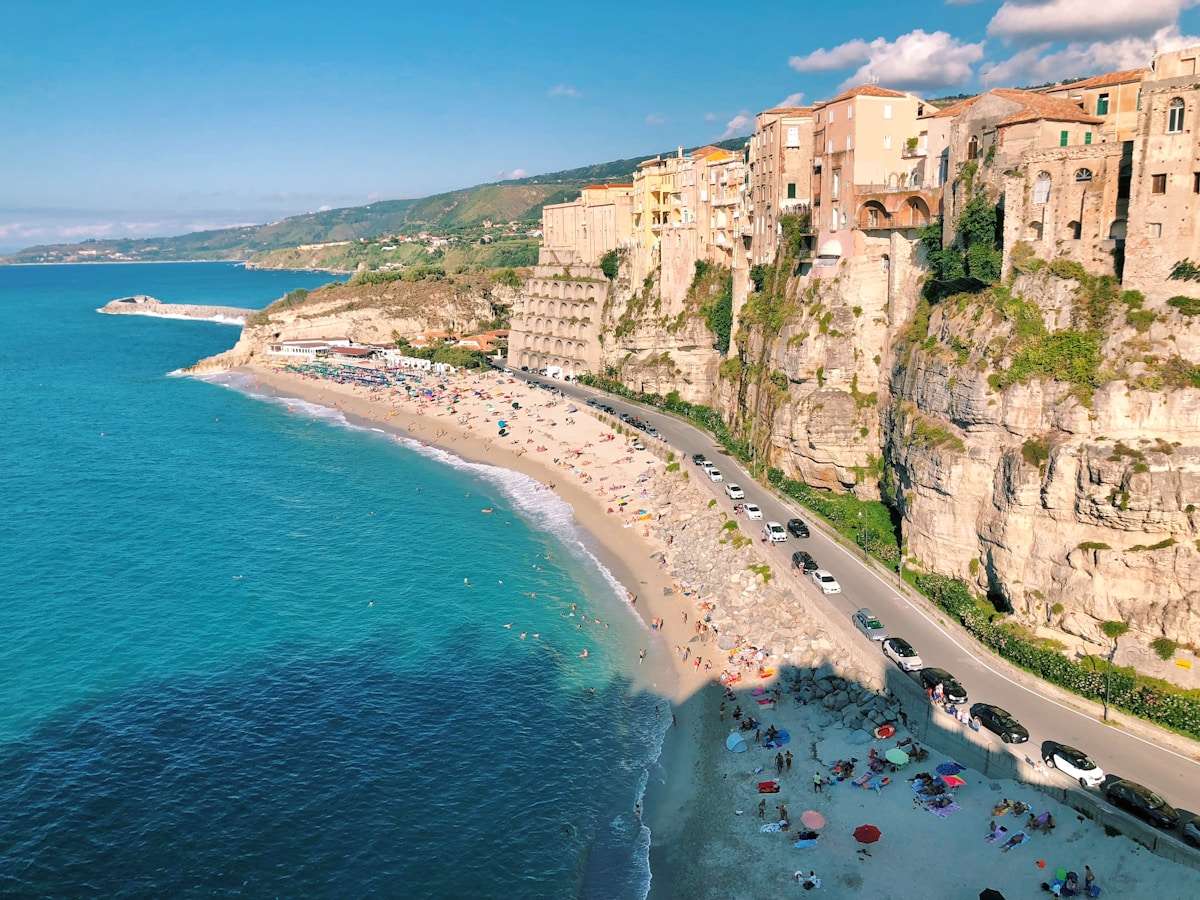
Tropea is a small town on the Tyrrhenian coast of Calabria — about 60,000 visitors arrive in July and August alone, into a permanent population of under 7,000. The appeal is direct: a medieval clifftop town above turquoise water, with beaches accessible by staircase and a small rocky church on a promontory offshore. It’s not complicated, and it doesn’t need to be.
The town is easily walkable. Most of what’s worth seeing is in the old town on the cliff or on the beach below. Outside the peak summer months, it’s a quiet and genuinely pleasant place.
The Old Town
Tropea’s historic centre occupies the top of the cliff above the sea. The main streets — Via Roma and Via Indipendenza — run roughly parallel to the coastal edge and connect the main sights. Both have cafes, delis selling the local red onion products, and belvedere viewpoints at the western end.
The Cattedrale di Maria Santissima di Romania stands on the highest point of the old town, visible from the sea. The cathedral dates from the Norman period (11th century), though it has been rebuilt and modified substantially over the centuries. Inside, a bronze votive bomb — a WWI-era bomb that failed to detonate — hangs near the entrance as a local offering to the Madonna. The 15th-century icon of the Madonna di Romania is kept in the apse. Entry is free; dress respectfully. Open generally 08:00–12:00 and 16:00–19:00, though hours vary seasonally.
Piazza Ercole is the main square on the cliff edge, with views directly over the sea. It’s the natural meeting point for the town and fills with people in the early evening. The western edge of the old town has several accessible belvedere viewpoints where the cliff drops sharply — these are the spots for the classic photos showing the town above the beach.
Santa Maria dell’Isola
The small church on a sandstone promontory at the northern end of town is Tropea’s most recognisable image. Despite the name, it’s connected to the mainland at the base — at low tide a path runs across, and from the town it’s reached via a flight of approximately 100 steps cut into the rock.
The church itself is modest — a single-nave structure rebuilt in the 20th century on earlier foundations — but the setting is extraordinary. The views from the top of the rock over the old town, the beach, and the sea in both directions are the reason to make the climb.
Entry is free. Hours are approximately 09:00–12:30 and 15:30–19:00, though this varies by season and day; the church is sometimes closed for restoration periods. The path down to the base of the rock from the old town is signposted.
The site is particularly worth visiting at sunrise (when light hits the cliff) or late afternoon before the sun drops behind the headland. The midday crush of visitors in high season makes it less pleasant between 11:00 and 14:00 in July and August.
Beaches
Spiaggia di Tropea is the main beach directly below the cliff. It’s a stretch of pale sand and clear water that’s earned its reputation — in terms of pure setting, it’s among the best beaches on mainland Italy. Beach clubs occupy most of the shoreline; a sunlounger and umbrella costs approximately €15–20 per day as of 2026. In July and August, the beach is packed by 10:00.
Spiaggia del Cannone is the southern section of the same beach, slightly further from the town access points and correspondingly quieter. It’s still on the beach club circuit but less dense.
La Rotonda and the beaches around Capo Vaticano (approximately 12km south, reachable by car or local bus) have wider, less crowded sand and arguably clearer water than the town beach. This area is worth the effort in July and August when the Tropea beach is at maximum density.
The water quality along this coast is generally good — the area regularly receives Blue Flag certification for beach cleanliness.
Cipolla Rossa di Tropea
The Tropea red onion (cipolla rossa di Tropea IGP) is the town’s food identity. These onions are sweeter than standard red onions — low in pyruvic acid, which makes them mild enough to eat raw without the sharpness that makes raw onion unpleasant. They’re grown in the soils between Tropea and the Capo Vaticano area.
The Mercato Coperto (covered market) at Largo Galluppi runs mornings only (roughly 07:30–13:00) and sells fresh onions direct from local growers, alongside preserves, jams, and dried products made with them. A bunch of fresh onions costs approximately €2–3. This is the right place to buy rather than the tourist shops, which sell the same products at higher prices in nicer packaging.
Mostarda di cipolla rossa — a sweet-sharp onion jam — and marmellata di cipolla rossa (onion marmalade) are the most popular preserved forms to take home.
Boat Trips
The port below the cliff operates local boat trips throughout the season (typically May–October). Shorter trips of 30–45 minutes explore the sea caves and grottoes at the base of the cliff; longer trips of 90 minutes extend south toward Capo Vaticano. Prices are approximately €15–25 per person depending on duration and operator, as of 2026.
Boats depart from the small harbour at the base of the cliff (Largo Testa di Ercole) — operators are visible dockside in the morning. In high season, early morning departures (before 10:00) have better water clarity and fewer boats in the water simultaneously.
Practical Notes
Tropea is reached by train on the Tropea branch line off the main Calabrian coastal railway — the nearest mainline junction is Rosarno (45 minutes from Reggio Calabria). The town’s train station is a 15-minute walk from the old town centre.
Parking in town in July–August is very difficult. The parking areas at Largo Villaggio and the approaches to the town fill by 09:00 on summer weekends. If arriving by car, come early or stay overnight.
The old town is largely pedestrianised; most streets within the historic centre are inaccessible to cars. This makes it a pleasant place to walk but means luggage needs to be carried on foot if staying in town.
Where to stay in Tropea: Find hotels in Tropea — search accommodation across all budgets.