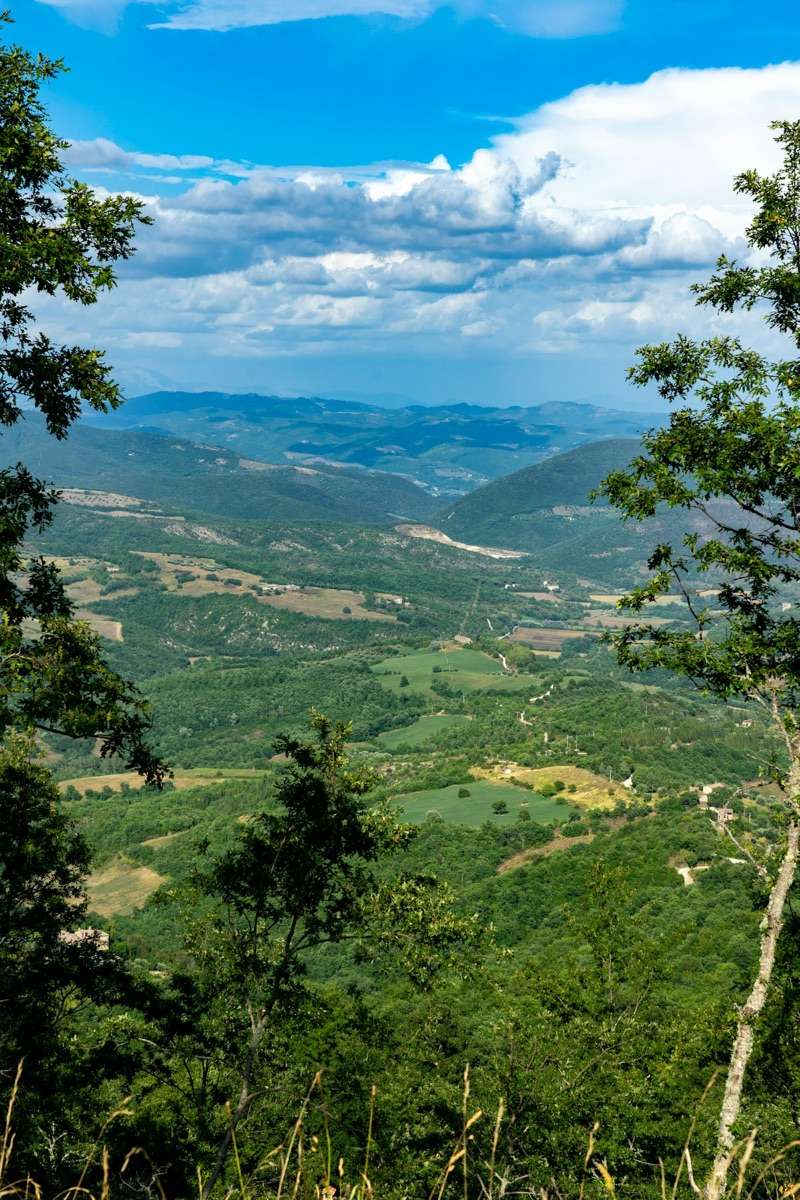
Spoleto is one of Umbria’s most complete medieval towns — less visited than Assisi but arguably richer in serious monuments. The Duomo has 15th-century frescoes by Filippo Lippi. The Ponte delle Torri is a 230-metre aqueduct-bridge crossing an 80-metre gorge. The Rocca is a 14th-century papal fortress that dominates the hilltop. And every summer, one of Italy’s most respected performing arts festivals takes over the town’s Roman and medieval stages.
Below we cover the main things to do in Spoleto, with opening hours, admission prices, and practical directions as of 2026.
Duomo di Spoleto
Piazza del Duomo sits at the heart of the old town and the Romanesque cathedral facing it — consecrated in 1198 — is Spoleto’s finest building. The facade is remarkable: eight rose windows of different sizes arranged across the upper tiers, and a 12th-century Byzantine-style mosaic of Christ enthroned over the entrance portal. The campanile (bell tower) incorporates Roman stonework at its base.
Inside, the main draw is the cycle of frescoes covering the apse, painted by Filippo Lippi between 1467 and 1469. These depict the Life of the Virgin — the Annunciation, the Nativity, the Dormition of the Virgin, and the Coronation. Lippi was working near the end of his life when he took the commission, and the frescoes are considered among his finest achievements. He died in Spoleto in 1469 before the project was fully complete; his tomb is in the right transept. The marble surround of the tomb was designed by his son Filippino Lippi.
Entry to the cathedral is free. It is open daily from 8:30 to 19:00 (shorter hours in winter — approximately 8:30 to 12:30 and 15:00 to 18:00).
Ponte delle Torri
The Ponte delle Torri (Bridge of the Towers) is the most dramatic sight in Spoleto — a 230-metre-long, 80-metre-high medieval aqueduct-bridge spanning the gorge between the Spoleto hill and the forested slope of Monteluco. It was built in the 13th–14th centuries, almost certainly on Roman foundations, and its ten Gothic arches are remarkably well preserved. The central arch is the highest, and looking down from the walkway into the gorge is genuinely vertiginous.
The bridge is free to cross on foot and accessible via a path that descends from the Rocca Albornoziana (about a 15-minute walk from the Duomo). Walk across to the Monteluco side for the best views back towards the fortress, then either return on the bridge or continue up through the oak forest to the small Franciscan hermitage of Sant’Eufrasia. The full walk from the Rocca to Monteluco and back takes about 2 hours at a relaxed pace.
La Rocca Albornoziana
The Rocca Albornoziana is the 14th-century papal fortress that sits at the highest point of Spoleto’s hill — an imposing structure of towers and defensive walls commissioned by Cardinal Albornoz in 1359 to reassert papal authority in central Italy. For centuries after its military function lapsed, it served as a prison. It was only decommissioned as a prison in 1982.
Today the Rocca houses the Museo Nazionale del Ducato di Spoleto across two internal courtyards. The museum covers the Lombard Duchy of Spoleto (7th–8th century), one of the most powerful Lombard territories in Italy, with carved stone reliefs, jewellery, and architectural fragments. Entry is approximately €5–8 (check current rates at the ticket office). The upper courtyard has excellent views over the Ponte delle Torri and the valley beyond. Open daily approximately 8:30 to 19:30 in summer, with reduced winter hours.
Teatro Romano
Spoleto’s Roman theatre dates from the 1st century AD and is among the best-preserved in central Italy. The semicircular cavea (seating bank) and much of the stage wall (scaena) survive intact, giving a clear sense of the original building’s scale. The theatre accommodated an estimated 3,000 spectators.
During the Festival dei Due Mondi, the Roman Theatre becomes one of the primary outdoor performance venues. Outside festival season it is a quieter archaeological site, visited alongside the Museo Archeologico Nazionale di Spoleto, which occupies the adjacent former monastery of Sant’Agata. The museum holds Roman inscriptions, sculpture, and decorative fragments from the theatre and surrounding area. Entry to the theatre and museum is approximately €3. Open Tuesday–Sunday 8:30 to 19:30.
Basilica di San Salvatore
The Basilica di San Salvatore stands just outside Spoleto’s walls along the old Via Flaminia, in the lower town’s cemetery district. It is one of the most significant early Christian buildings in Italy — a UNESCO World Heritage Site (inscribed as part of the serial site “Lombards in Italy”) — dating from the late 4th or early 5th century AD. The three-aisled basilica reuses Roman marble columns and Corinthian capitals from an earlier pagan building, and the carved facade with its pilasters and blind arches shows the direct transition from classical Roman to early Christian architecture.
The interior is simple and austere — deliberately so. Entry is free. Open daily.
Festival dei Due Mondi
The Festival of Two Worlds was founded in 1958 by the Italian-American composer Gian Carlo Menotti, who chose Spoleto for its combination of intact medieval theatre spaces and relative absence of tourism. The festival runs for 10–14 days in late June and early July, using the Roman Theatre, the Teatro Caio Melisso, the Piazza del Duomo (for large outdoor concerts), and the Teatro Nuovo as its main venues.
The programme covers opera, ballet and contemporary dance, classical music, theatre, and installations. It has a reputation for mixing world premieres with standard repertoire, and for programming younger choreographers and directors alongside established names. Tickets start at approximately €15–20 for outdoor events; main opera and ballet performances typically run €50–100 or more. Book from January on the official website at festivaldispoleto.com. Hotels fill quickly during festival weeks — book accommodation at least two to three months ahead.
The Spoleto Walking Circuit
The town’s medieval walls and the surrounding paths allow a satisfying half-day circuit that covers most of the major sights. A practical loop: begin at Piazza della Libertà (main bus stop from the railway station), walk south-east to the Teatro Romano, then climb via Via del Ponte to the Rocca Albornoziana. From the Rocca, a signed path descends to the Ponte delle Torri — cross it, turn right through the Monteluco forest (about 3km of shaded path), and re-enter the town via the upper Porta Loreto gate. Return through the narrow medieval streets past the Duomo to Piazza della Libertà.
The full circuit takes 3–4 hours on foot and costs nothing. Wear shoes with a grip — the cobbled streets around the Rocca are steep. The Monteluco section is shaded and cool even in summer.
Practical Information
Spoleto station sits about 1km below the historic centre, connected by local bus (approximately €1.30 per journey) or a 15-minute uphill walk. Taxis wait outside the station. The historic centre is fully pedestrianised. Most sights are within a 20-minute walk of the Duomo. Paid parking is available at Piazzale Vittoria (outside the walls, eastern side) and Piazza Campello near the Rocca. The town has a limited tourist office at Piazza della Libertà 7, open weekdays and weekend mornings.
Where to stay in Spoleto: Find hotels in Spoleto — search accommodation across all budgets.