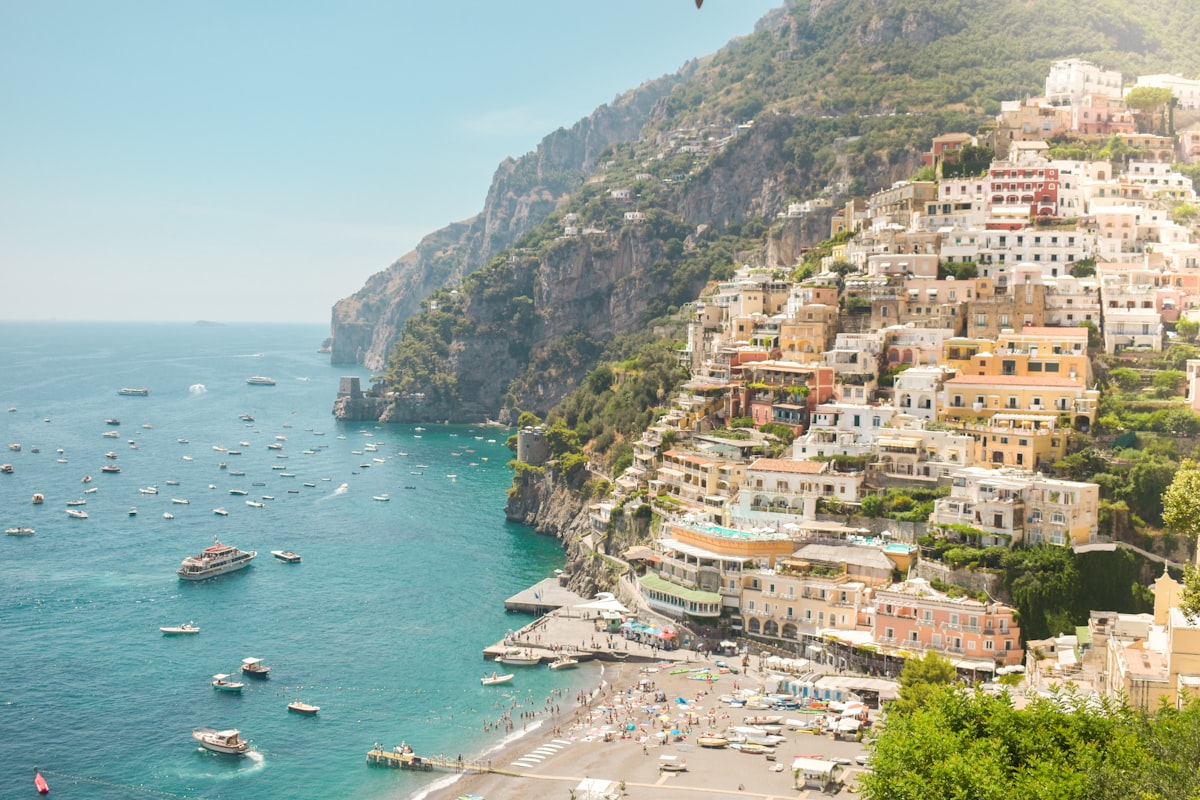
Positano occupies one of the most dramatic settings on the Amalfi Coast - a vertical village where pastel-coloured houses stack up a steep ravine above a small pebble beach, with the Mediterranean visible between every building and from every terrace. It is also one of the most visited small towns in Italy, which means logistics matter. Understanding how the place works - how to get in, where to go, what to do in what order - separates a good visit from a frustrating one.
Spiaggia Grande
The main beach, Spiaggia Grande, is a broad crescent of dark pebble directly below the centre of the village. It is never quiet in summer, but it is undeniably beautiful - the coloured houses rising behind it, the fishing boats pulled up at the western end, and the water a clear, deep blue.
Sunbeds and umbrellas on the lido sections cost approximately €20–30 per person per day as of 2026, depending on position and establishment. The public section of the beach (free) occupies the eastern end and is genuinely viable - bring a towel and stones for the pebbles. Arrive before 10am to get a good spot in July or August.
The beach is reached by a long staircase (or the path of stairs to the left of the main road as you enter Positano from above). There are no flat alternatives - Positano is built almost entirely on vertical terrain, and the beach is at the bottom of it.
Top Tours at a Glance
| Tour | Duration | Price (from) | Group Size | Highlights |
|---|---|---|---|---|
| Positano boat trip — Li Galli and sea caves | 3 hrs | from €35 | Up to 12 | Li Galli islands, Grotta dello Smeraldo, swim stop |
| Path of the Gods guided hike from Positano | 5 hrs | from €45 | Up to 10 | Agerola to Nocelle, transport, guide, coast views |
| Amalfi Coast boat tour from Positano | 4 hrs | from €55 | Up to 12 | Amalfi, Ravello coast, private coves |
| Private boat hire — Positano to Capri | Full day | from €250 | Private | Capri, Faraglioni, Blue Grotto, flexible itinerary |
Browse all Positano tours → GetYourGuide
Spiaggia del Fornillo
A 10-minute walk west of Spiaggia Grande along the coastal path brings you to Fornillo, a smaller and significantly quieter beach with the same dark pebble surface. The path passes the Torre Trasita tower and skirts the cliff face - it is one of the nicest short walks in Positano. Fornillo has two lido establishments (sunbeds approximately €15–25/day as of 2026) and a couple of beach bars. The atmosphere is more local and less intense than Spiaggia Grande, and the swimming is just as good.
Boat Tours
A boat trip is the best way to understand Positano’s geography and to reach places inaccessible on foot. Several operators work from the beach, running half-day and full-day tours along the coast.
Grotta dello Smeraldo - the Emerald Grotto near Conca dei Marini is Positano’s answer to Capri’s Blue Grotto: a sea cave with green-reflecting water created by submerged light. Entry by boat tour or by stairs from the SS163 above (approximately €5 as of 2026 for the elevator and cave entry). Most Positano boat tours include it.
Li Galli Islands - three small islands visible from Positano’s beach, historically said to be where the Sirens lived. They are privately owned (the dancer Rudolf Nureyev spent his later years here) and inaccessible on foot, but boat tours circle them and stop for swimming nearby. The water around Li Galli is exceptionally clear.
Shared Positano boat tours depart from Spiaggia Grande and cost approximately €25–40 per person as of 2026 for a half-day tour. Private boat hire from Marina di Positano runs from approximately €150 for a half-day as of 2026 for a small speedboat. Book in advance in July and August - operators fill up.
The Path of the Gods (Sentiero degli Dei)
The most celebrated hiking trail on the Amalfi Coast starts above Positano and runs along the ridge connecting Agerola to Nocelle, a hamlet perched above the village. The trail is approximately 7.5km and climbs to roughly 600 metres above sea level, with views over the full sweep of the coast - Positano below, Capri in the distance, the Faraglioni on clear days.
The standard direction is Agerola to Nocelle (west to east), finishing above Positano with a long descent (approximately 1,800 steps) to the village below. Agerola is reached by bus from Amalfi town (approximately 1 hour, approximately €2 as of 2026). The full hike including the descent takes 4–5 hours; budget more if you stop frequently to photograph. The path is rocky and sometimes narrow - proper hiking footwear is not optional, whatever the Instagram accounts suggest.
The best months for the hike are April to June and September to October. In July and August the trail can be dangerously hot by 10am, and the descent to Positano in the afternoon heat is not pleasant. For guided Sentiero degli Dei walks from Positano with transport to the Agerola starting point arranged, book a few days ahead in season.
The Church of Santa Maria Assunta
Positano’s main church stands at the top of the main beach staircase and is free to enter. The 13th-century Byzantine icon of the Black Madonna above the altar is the town’s most revered object - legend holds that a pirate ship carrying it was blown off course and anchored here when a divine voice told the crew to stop. The tiled dome visible from the beach and from all approaching boats is a landmark recognisable across the southern Amalfi Coast.
Ceramic Shopping on Via dei Mulini
Via dei Mulini is Positano’s main shopping street, descending from the SS163 to the beach through a series of switchbacks. The boutiques sell hand-painted ceramics, linen clothing, sandals, and limoncello, often at prices inflated for the tourist footfall. The ceramics - particularly the white-and-blue Vietri sul Mare style - are genuine local craft and worth buying: a decent plate or bowl costs approximately €15–40 as of 2026 depending on size and complexity.
The beachwear shops sell the floaty linen dresses and trousers that Positano has become internationally associated with. Prices are reasonable relative to the setting - approximately €40–80 for a dress as of 2026.
Positano at Night
The village’s atmosphere changes substantially after 6pm when the day visitors leave. The bars along the beach fill with a more relaxed crowd, the restaurants open for dinner, and the steep lanes are quieter. Sunset from Spiaggia Grande or from the terrace of any bar with a sea view is exceptional - the light on the water and the silhouette of the houses is exactly what the photographs suggest.
Dinner at a good restaurant in Positano costs approximately €40–60 per person as of 2026 with wine. The quality at the mid-range places is high - fresh seafood, local pasta (scialatielli is the local shape), and Campanian wines.
Visiting Off-Season
October is the best-kept secret of the Amalfi Coast. The sea temperature is still warm (around 22°C), the light is softer than in summer, hotels discount by 30–40%, and the village is genuinely walkable without queuing. The restaurants are still open, the boat operators still run, and the Path of the Gods is at its most comfortable temperature.
Positano is largely closed from November to March. Many hotels, restaurants, and shops shutter for the winter, and the ferry services to Naples and Capri suspend. If you visit in this period, confirm in advance that your accommodation and intended activities are actually open.
Getting There Without a Car
Positano has no car park worth mentioning and the approach roads are narrow mountain passes that require confident driving. The practical advice for most visitors is simple: do not drive.
By SITA bus from Sorrento: The SITA bus runs along the SS163, the famous Amalfi Drive, connecting Sorrento with Positano and continuing to Amalfi. From Sorrento the journey takes approximately 1 hour and costs approximately €1.30 as of 2026. Buy tickets at a tabacchi before boarding. The buses are crowded in summer and standing is common - arrive at the Sorrento stop early for a seat.
By ferry from Sorrento: A seasonal ferry runs between Sorrento and Positano (approximately 35 minutes, approximately €15–18 as of 2026). This is the most comfortable option and avoids the SS163 entirely. Ferries also run from Naples and Amalfi in season.
By taxi or private transfer: A private transfer from Sorrento costs approximately €70–100 as of 2026 for up to four passengers, and from Naples airport approximately €120–150. The road from Sorrento (approximately 18km) takes 45–60 minutes depending on traffic - the SS163 is genuinely narrow in places and traffic jams in summer are real.
Where to stay in Positano: Find hotels in Positano — search accommodation across all budgets.