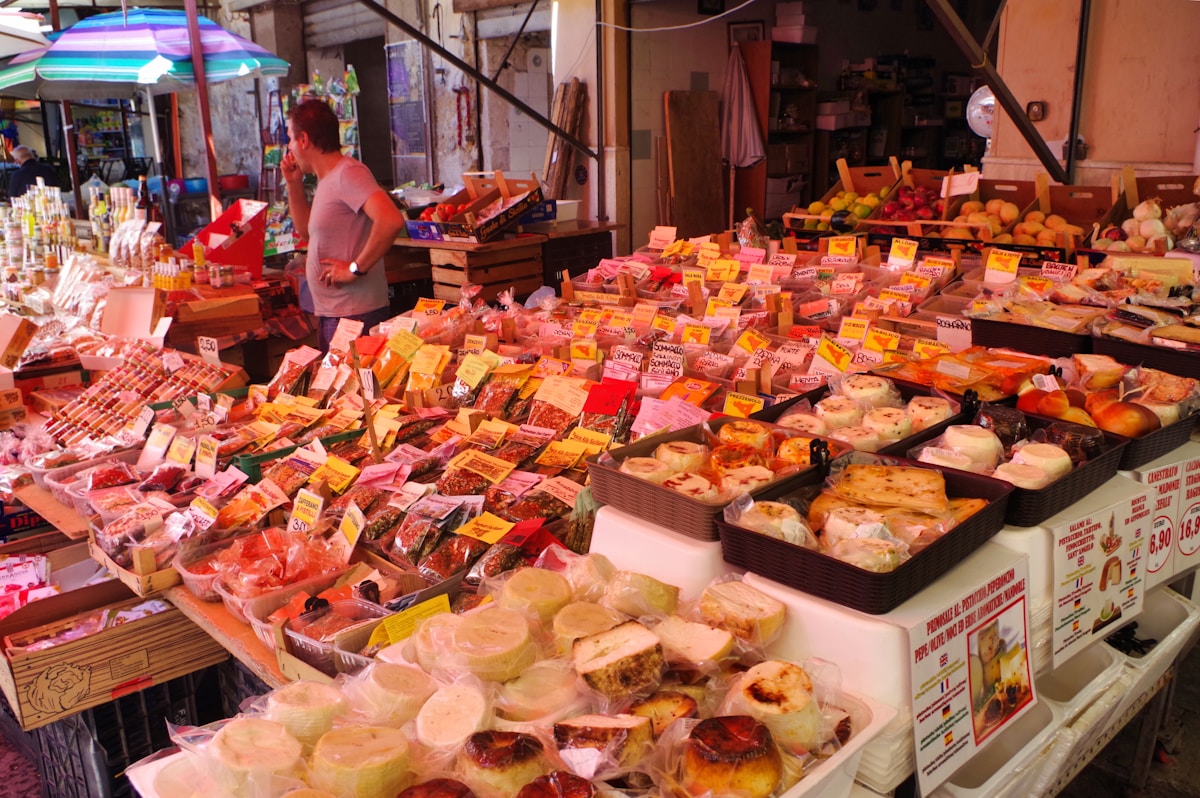
Palermo has the most distinctive and diverse street food culture in Italy - a direct consequence of the city’s history as a crossroads of Mediterranean civilisations. The Arab influence is visible in the use of sweet-sour combinations, raisins and pine nuts in savoury dishes, and the chickpea fritters that are a North African staple; the Norman influence shows in the pastry techniques; the Spanish in the stuffed and fried formats. The result is a food culture unlike any other in Italy, available from market stalls, friggitorie, and traditional pasticcerie in the historic centre.
Street Food at Ballarò
The Ballarò market in the Albergheria district is the main stage for Palermo street food. It operates daily from early morning, with the food stalls most active from 8am to 1pm. The produce and food supply function of the market means it’s genuinely working - not staged for tourists.
Panelle are chickpea fritters: batter made from chickpea flour, water, salt, and parsley is spread thin and fried in oil, then served in a sesame roll (mafalda) with cazzilli (potato croquettes) or alone. The combination of the slightly nutty chickpea and the potato in the same roll is the classic panino con le panelle. Approximately €2–3 at a proper friggitoria, considerably cheaper than the equivalent tourist-area version.
Stigghiola are lamb or chicken intestines wrapped around spring onions, salted, and grilled over charcoal. The smell is pronounced and the flavour is strong - this is not subtle street food. O’ Stigghiolare near Piazza del Carmine is the most established vendor; they’ve been doing this since the 1970s. Approximately €3–5 as of 2026.
Sfincione - the Palermitan pizza - is the thickest and most heavily loaded of all Italian flatbreads: spongy dough, tomato and onion sauce, anchovies, dried caciocavallo or tuma cheese, and breadcrumbs on top. Eaten cold or room temperature from bakery counters across the city. Approximately €2–3 per slice.
Frittola - a mix of cartilage, skin, and small cuts of veal, fried and served wrapped in paper. Challenging, inexpensive, historically the food of those who couldn’t afford the prime cuts. Friggitoria Chiluzzo near the Vucciria market serves it. Approximately €2–3.
Pasta con le Sarde
The Arab-Norman signature dish: bucatini (thick hollow spaghetti) with fresh sardines, wild fennel (finocchietto selvatico), saffron, raisins, pine nuts, and anchovy. The result is complex, sweet-sour-savoury, and unlike anything else in Italian regional cooking. The wild fennel is essential - the cultivated fennel bulb doesn’t produce the same anise intensity.
Trattoria Biondo (Via Carducci 15) is a long-running family restaurant known for this dish among a small menu of Sicilian classics. Approximately €12–14. Best at lunch when it’s made fresh.
Osteria Ballarak (Via Ballarò) makes a good version using ingredients from the adjacent market - the transparency of sourcing adds to the reliability. Approximately €13.
Pasta alla Norma and Seafood Pasta
Pasta alla Norma - fried aubergine, tomato, ricotta salata, basil - is the eastern Sicilian dish that has spread island-wide, including to Palermo. Less local here than pasta con le sarde, but better versions are found in Palermo than in the tourist restaurants of Taormina (where it’s made for volume rather than quality).
Spaghetti ai ricci di mare (sea urchin pasta) appears seasonally in Palermo’s better restaurants - the roe of the red sea urchin from the Sicilian coast is intensely flavoured and creamy when tossed with pasta and a little olive oil. Approximately €20–25 as of 2026 in the restaurants that make it well.
Cassata Siciliana
The layered pastry that is Sicily’s most operatic dessert - a construction of sponge, sweetened sheep’s ricotta, marzipan, chocolate, and candied citrus peel that takes hours to assemble properly. The green outer layer is pasta reale (royal paste - pistachio or almond marzipan coloured with pistachios).
Pasticceria Cappello (Via Colonna Rotta 68) is considered the best cassata source in Palermo - they’ve been making it for over 60 years. A slice costs approximately €5–6 as of 2026. The whole cake is approximately €40–60.
Pasticceria Mazzara (Via Generale Magliocco 15) is the other reference point - slightly more formal, with a wider range of Sicilian pastries alongside the cassata.
Cannoli
As in all of Sicily, the cannolo in Palermo is made properly only at a good pasticceria - the shell fried fresh, the filling (sheep’s ricotta, sugar, chocolate chips, candied citrus) made the same day. The key: the shell must be filled to order. A pre-filled cannolo that has been sitting for 2 hours is a different and inferior product.
Bar Pasticceria Frabboni (Via Roma) fills to order and makes shells daily. Approximately €2 each as of 2026.
Cannolo di Marsala - a variant using Marsala wine in the shell dough - appears at some Palermo pasticcerie and is worth trying if you encounter it.
Arancini
Palermo uses the feminine form - arancine - and makes them typically as balls (spherical) rather than the conical versions of eastern Sicily. The classic fillings:
- Arancina al ragù - meat ragù with tomato, peas, and mozzarella
- Arancina al burro - butter, mozzarella, and prosciutto cotto (the Palermitan version)
- Arancina agli spinaci - spinach and mozzarella, less common but good
Bar Touring (Via Roma 258) is frequently cited as the best for arancine in central Palermo - approximately €2.50–3.50 as of 2026. They make them fresh throughout the day rather than in a single morning batch.
Wine: Grillo, Nero d’Avola, and Marsala
Grillo is the white grape of western Sicily - full-bodied, slightly oxidative, good with fish and the stronger flavours of Sicilian street food. Nero d’Avola (the red) is the island’s most widely planted variety: full, warm, plummy, and produced across all quality levels from table wine to serious aged examples. Marsala (from the town of the same name on Sicily’s west coast) is the fortified wine that gave the island its international wine reputation - dry Marsala Vergine is the serious version, used for cooking and as an aperitivo; the sweet commercial versions are primarily for export.
A glass of local wine at a Palermo bar costs approximately €4–8; a bottle of decent Nero d’Avola at a trattoria approximately €20–35 as of 2026.
For guided food tours with tastings, browse food and market tours in Palermo.
Take a Guided Food Tour of Palermo
Palermo’s food markets — Ballarò, Vucciria, and Capo — are three of the most atmospheric in Italy, each with different character and different street food specialities. The city’s food is genuinely hybrid: Arab, Norman, and Spanish layers visible in a single dish like the pasta con le sarde or the caponata. A guided street food tour through Ballarò, covering panelle, arancini, and stigghiola from the vendors who know them best, is the most direct way into Palermo’s food culture. Browse Palermo food tours on GetYourGuide.
Where to stay in Palermo: Find hotels in Palermo — search accommodation across all budgets.