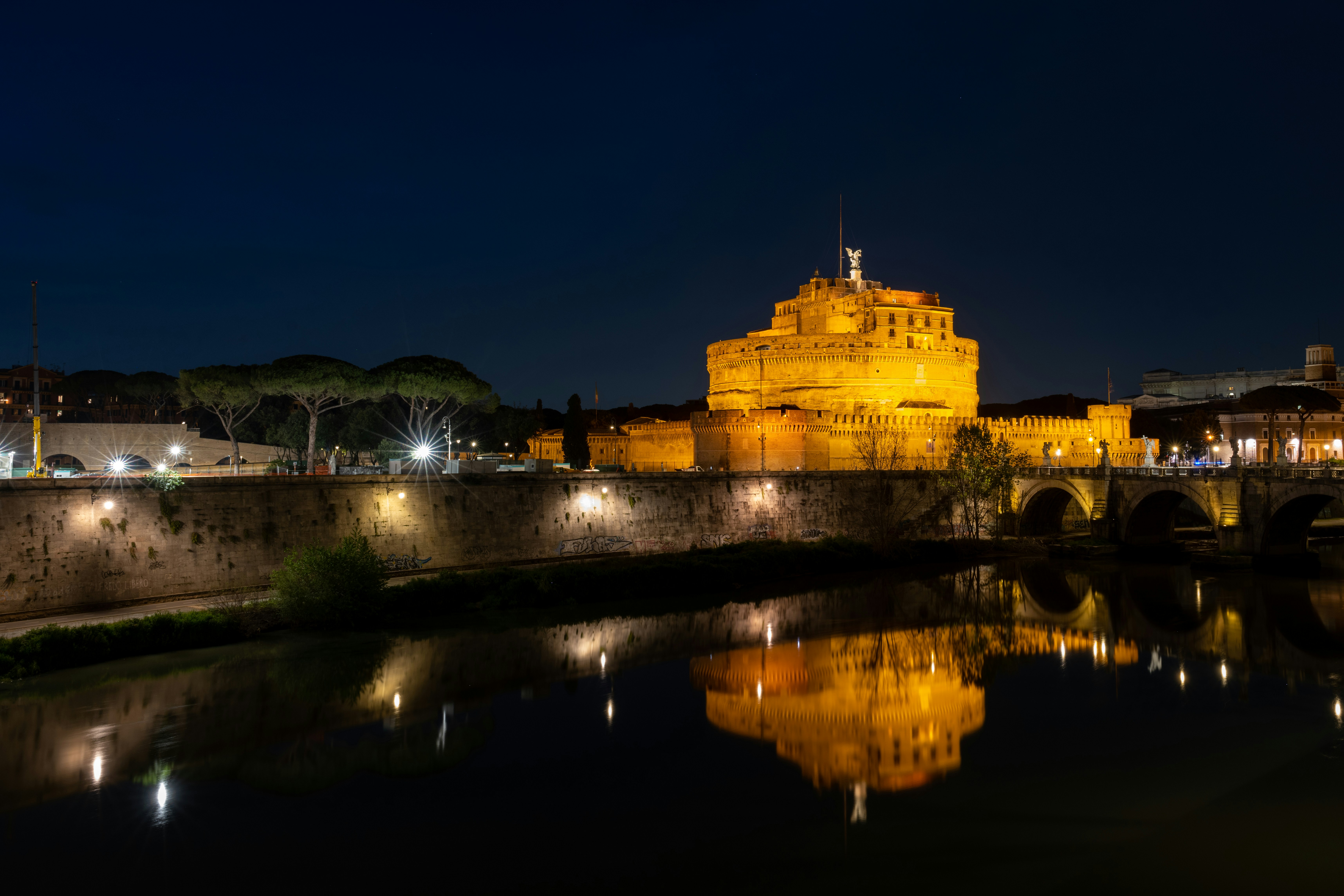
Castel Sant’Angelo stands on the right bank of the Tiber, connected to the Vatican by an elevated fortified corridor and linked to the historic centre by the Ponte Sant’Angelo - a pedestrian bridge lined with Bernini’s angels. The building began as the mausoleum of Emperor Hadrian in 135–139 AD, grew into a medieval fortress under successive popes, and spent centuries as the most strategically important building in Rome. Today it is one of the city’s major museums, with an extraordinary rooftop terrace that offers unobstructed views across the city.
Top Tours at a Glance
| Tour | Duration | Price (from) | Group Size | Highlights |
|---|---|---|---|---|
| Castel Sant’Angelo skip-the-line guided tour | 1.5 hrs | from €35 | Up to 20 | Entry included, rooftop terrace, papal history |
| Vatican + Castel Sant’Angelo combo | 4 hrs | from €65 | Up to 15 | Vatican Museums, Sistine Chapel, Castel Sant’Angelo |
| Rome evening highlights with Sant’Angelo | 3 hrs | from €45 | Up to 20 | Tiber walk, Ponte Sant’Angelo, night views |
| Private Castel Sant’Angelo tour | 2 hrs | from €80 | Private | Fully tailored, expert art historian guide |
Browse all Rome tours → GetYourGuide
Entry Fees (as of 2026)
| Ticket | Price |
|---|---|
| Standard adult | approximately €15 |
| EU citizens 18–25 | approximately €2 |
| Under 18 (EU residents) | Free |
| Online reservation fee | approximately €3–4 |
| Audio guide | approximately €5 |
Current prices are set by the Italian Ministry of Culture (MiC) and subject to change. Verify at castelsantangelo.beniculturali.it before booking.
Where to Book
Direct booking: castelsantangelo.beniculturali.it - official site, lowest base price.
Third-party tickets with guided tour: Platforms including GetYourGuide, Tiqets, and Viator offer bundled entry-plus-guide tickets. These are particularly useful for first-time visitors who want historical context. Booking through GetYourGuide is the most reliable option. Private guided tours typically start from approximately €35–60 per person including entry.
Rome multi-site passes: The Roma Pass (approximately €32 for 48 hours as of 2026) includes free or reduced entry to two museums and public transport. Castel Sant’Angelo is one of the eligible sites - worth calculating if you plan to visit two or more museums in 48 hours.
Opening Hours
Castel Sant’Angelo is open daily from 09:00 to 19:30 (last entry at 18:30). The castle is closed on Mondays, 1 January, 1 May, and 25 December.
During summer evenings (typically June to September), the rooftop terrace sometimes hosts evening opening with live music - check the official site for the current programme. These are separate ticketed events.
Getting There
The castle is on Lungotevere Castello, a 15-minute walk from the Vatican Museums along the river, and approximately 25 minutes on foot from Campo de’ Fiori.
By metro: The nearest metro is Lepanto (Line A), approximately 10 minutes on foot. Ottaviano (Line A) is slightly further but drops you close to the Vatican if you’re combining visits.
By bus: Lines 23, 40, 62, and 982 stop near Castel Sant’Angelo. From Termini, take line 40 or 62 directly.
On foot from the Vatican: Exit the Vatican Museums and follow Via della Conciliazione east towards the Tiber - the castle is visible from the road.
What to See Inside
The Mausoleum Level (Bottom)
Hadrian’s original funerary structure forms the base of the castle. The spiral ramp (rampa elicoidale) that winds up the interior is original Roman construction - one of the best-preserved examples of Roman internal ramp architecture. The burial chamber where Hadrian’s ashes were interred is accessible and still intact in structure.
Medieval Military Rooms
The intermediate levels contain the rooms used during the castle’s centuries as a papal fortress - storage areas for weapons and ammunition, oil vats for defensive fire, and the infamous prisons. The most notorious cell, the Oubliette, held prisoners including the sculptor Benvenuto Cellini, who described his captivity in his autobiography.
Papal Apartments (Level 4 and 5)
Pope Paul III commissioned a suite of apartments in the 16th century that rival the quality of rooms in the Vatican palaces. The Sala Paolina (Paul’s Hall) has frescoes by Perino del Vaga depicting Alexander the Great - an allegory for papal power. The connecting bathroom, decorated for Pope Clement VII, is one of the few surviving Renaissance private bathrooms with intact tile work and painted decoration.
The Treasury Room
The Sala del Tesoro (Treasury Room) was where the papacy kept its gold reserves, documents, and valuables. A large chest - the Chest of Pope Boniface VIII - survives in the room. The room’s fortified construction is visible in the thickness of the walls and the iron-reinforced door.
The Rooftop Terrace
The rooftop (Terrazza dell’Angelo) is the castle’s most celebrated feature. The bronze angel statue above - the Archangel Michael sheathing his sword - is a 1752 bronze by Flemish sculptor Peter Anton von Verschaffelt replacing earlier marble versions. The terrace affords 360-degree views: St Peter’s dome to the west, the curve of the Tiber below, and the rooftops of the historic centre stretching east.
In good light conditions, the rooftop view of St Peter’s is considered superior to many of the Vatican’s own viewpoints because of the angle and distance. Bring a camera.
The Passetto di Borgo
The elevated corridor connecting Castel Sant’Angelo to the Vatican was built in 1277 under Pope Nicholas III. It allowed popes to reach the castle from the Vatican without descending to street level - critical during sieges and political crises. Pope Alexander VI used it in 1494 during the French invasion of Rome; Clement VII escaped along it during the Sack of Rome in 1527.
The Passetto is occasionally opened to visitors on special event days - check the official calendar. It is not part of the standard visit.
Practical Tips
- Best time to visit: Early morning (09:00 opening) or after 15:00. Midday in summer is the busiest period.
- Combine with Ponte Sant’Angelo: Cross the pedestrian bridge to/from the castle - the angel sculptures are Bernini’s original design, though most current statues are copies (originals are in the Borghese Gallery). The bridge itself is one of the most photographed spots in Rome.
- Wear good shoes: The spiral ramp and stone stairways require some effort. The rooftop can be windy even in summer.
- Café: There is a small café on one of the upper terraces. It is overpriced, as expected in major tourist sites, but the view compensates.