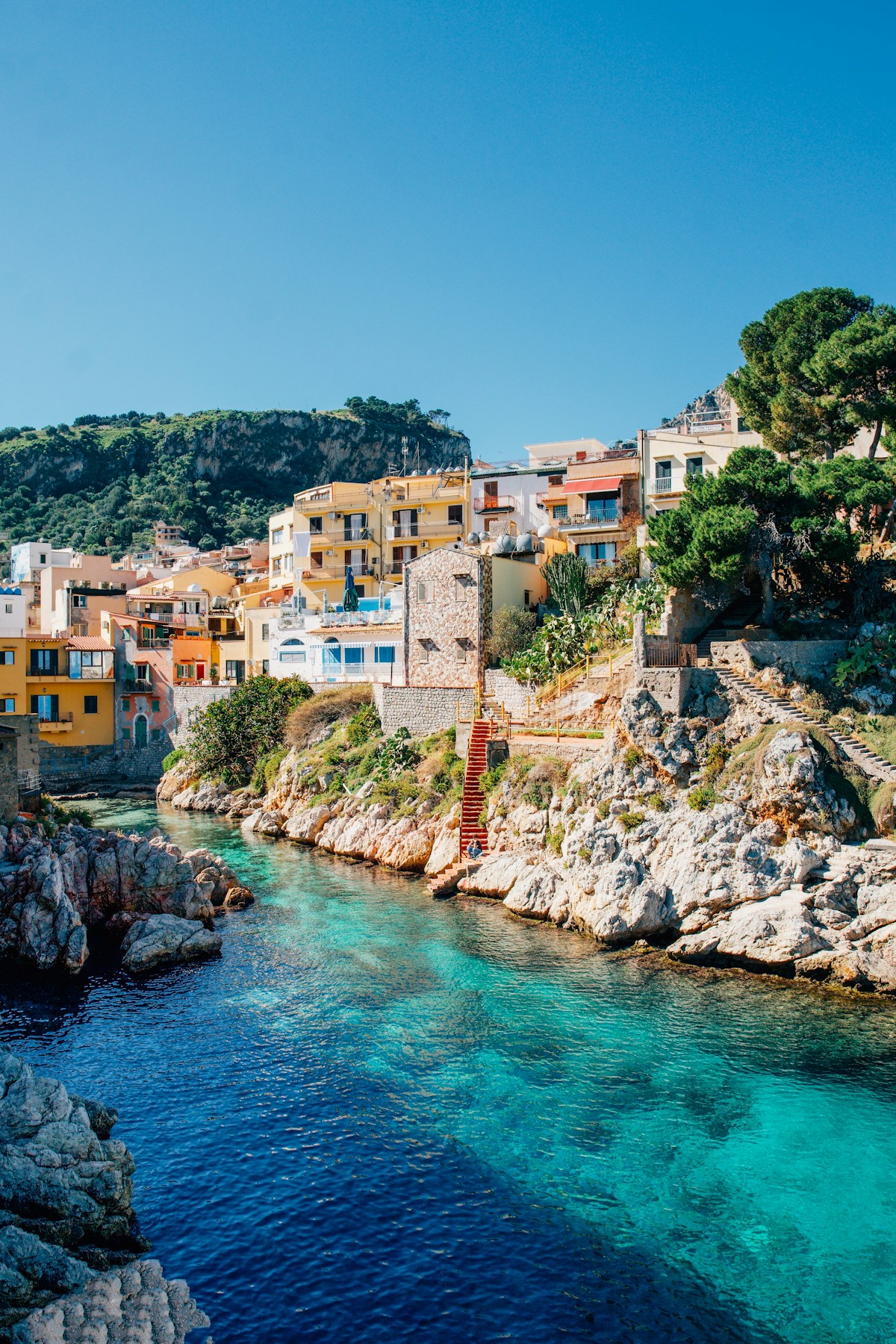
Sicily rewards time. The island is large - roughly the size of Wales - and the best experiences require spreading your stay across the coasts, the interior, and the mountain. Here is what to prioritise.
Walk the Valley of the Temples at Agrigento
The Valley of the Temples is one of the greatest archaeological sites in the world. Seven Doric Greek temples from the 5th century BC are scattered across a ridge above the south coast, in varying states of preservation. The Temple of Concordia is among the best-preserved Greek temples anywhere - still standing on all 34 columns. The Temple of Hera, the Temple of Castor and Pollux (four columns still standing), and the massive Temple of Zeus (which would have been the largest Greek temple ever built, had it been completed) complete the major structures.
Visit at dusk if you can - the golden light on the limestone and the lit-up temples after dark are exceptional. Allow 3–4 hours minimum. Guided tours of Sicily covering the Valley of the Temples, Palermo markets, and Etna are available as day excursions from the main cities.
Eat your way through Palermo
Palermo has the most distinctive and intense street food culture in Italy. The Ballarò, Capo, and Vucciria markets are not sanitised tourist experiences but working neighbourhood markets. The food:
- Arancini - fried rice balls; in Palermo they are spherical, in Catania they are cone-shaped
- Sfincione - thick-base pizza with tomato, anchovy, and caciocavallo, sold from market stalls
- Pani câ meusa - spleen sandwich. The most local food in Palermo, served from carts.
- Cazzilli - crispy potato croquettes
- Granita - at breakfast with brioche, particularly almond and pistachio
The Ballarò market runs every morning. The Capo market is adjacent to Via Maqueda.
Visit the Palatine Chapel and Monreale
The Norman-Arab-Byzantine architecture of Palermo is unlike anything else in Europe. The Palatine Chapel (Cappella Palatina) inside the Royal Palace is a 12th-century room covered floor-to-ceiling in gold mosaics depicting Biblical scenes, with an Arab muqarnas ceiling of painted stalactites and Latin and Greek inscriptions. It was built by Roger II (1130–1140) as his private chapel and synthesises three cultures in a single room.
Monreale Cathedral, 8km south-west of Palermo, scales this up dramatically. The apse mosaics show Christ Pantocrator in a mosaic 7 metres high. The entire interior covers 6,340 square metres of gold mosaic - the most complete surviving Byzantine mosaic programme after Hagia Sophia.
Climb or take the cable car up Etna
Mount Etna (3,329m) is the largest active volcano in Europe and one of the world’s most active. You can get close to the summit craters in several ways:
- Cable car (Funivia dell’Etna) from the south side to 2,500m, then 4WD jeeps up to ~2,900m, then walking to the crater rim area
- North side (Piano Provenzana) - less developed, the area damaged by 2002 lava flows is visible
- Trekking - numerous routes on the lower slopes through lava fields, chestnut forests, and ancient craters
The summit craters are closed when activity is elevated; check conditions before going. The cable car side (Rifugio Sapienza) is the standard tourist route. For a deeper experience, hire a guide for the summit craters.
Spend time in Taormina
Taormina is Sicily’s most famous resort town - a clifftop settlement above the Ionian Sea with Etna as the backdrop. The 3rd-century BC Greek theatre (later modified by the Romans) is the main sight: columns, sea views, and a perfectly framed Etna. The town itself is compact and expensive, with a main street (Corso Umberto) lined with boutiques and restaurants. Take the cable car down to Isola Bella - a small island connected to the mainland by a strip of pebble beach.
Avoid July–August unless you are booked months ahead.
See Syracuse’s ancient city
Syracuse was, in the 5th century BC, the most powerful city in the western Mediterranean - larger and richer than Athens. The evidence is in the Archaeological Park of Neapolis: a Greek theatre (dated to 5th century BC, still used for summer productions), a Roman amphitheatre, the Ear of Dionysius (a 65-metre-deep limestone quarry with extraordinary acoustics), and the Altar of Hiero II.
The old island of Ortigia, connected to the mainland by bridge, is a baroque town built on ancient foundations. The Cathedral incorporates columns from a 5th-century BC Greek temple into its wall - you can see them from inside. The Fountain of Arethusa, a freshwater spring by the sea shore, is one of the ancient world’s most famous landmarks.
Drive the south-west coast and Selinunte
The south-west coast between Agrigento and Trapani is less visited than the east but contains some of Sicily’s best experiences. Selinunte is a massive Greek archaeological park - temples in various states of ruin, one of which (Temple E) was reassembled from fallen blocks. The scale is vast; the park is 270 hectares. The salt pans near Marsala, with their white mounds and Dutch windmills, are a particular image of western Sicily.
The Valle del Belice contains the ruins of Gibellina, destroyed in the 1968 earthquake and never rebuilt - artist Alberto Burri covered the remains in white concrete, creating a landscape art piece called the Grande Cretto.
Day-trip to the Aeolian Islands
The Aeolian Islands (Isole Eolie), 50km north of Messina, are a UNESCO World Heritage archipelago of seven volcanic islands. Lipari is the largest and most developed; Stromboli has an almost constantly active volcano that can be climbed at night to watch lava fountaining from the summit craters; Panarea is the most fashionable. Hydrofoils run from Milazzo (40 minutes from Messina) year-round. Volcanic beaches - black sand and coloured pumice - are the signature.
Back to the full Sicily island guide for getting there, when to go, and where to stay. For the city hubs covered separately: Palermo travel guide and Taormina guide. For where to stay across the island: Sicily hotels guide. Planning a full trip? Our Sicily itinerary maps 10–14 days across the island’s main areas. For the food - arancini, granita, pasta alla Norma, cannoli - our Sicilian food guide is the companion piece. Comparing Sicily with Sardinia? Our Sicily vs Sardinia guide covers what each island offers.