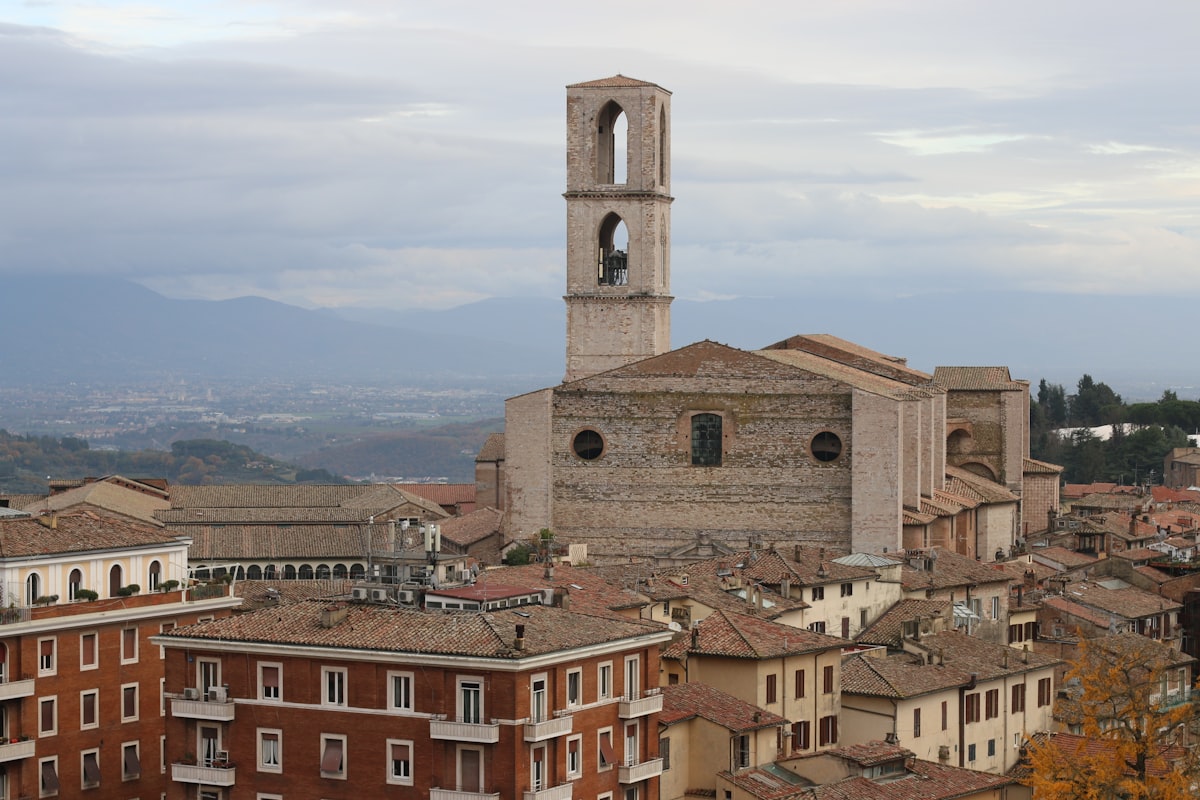
Perugia sits at around 450 metres above the Umbrian plain, its medieval lanes strung along a series of ridges above the modern lower city. Two universities, a celebrated jazz festival in July, and the Eurochocolate event in October make it one of central Italy’s most animated provincial capitals — and one of its most rewarding overnight stops. The key accommodation decision is simple: stay in the hilltop historic centre if you want atmosphere; stay near the station if you want the cheapest rates and don’t mind the escalator commute.
Why Stay in the Historic Centre
The upper city’s Piazza IV Novembre — anchored by the Gothic Palazzo dei Priori and the medieval Fontana Maggiore — is one of the finest public spaces in Italy. Staying inside the walls means you can walk the main Corso Vannucci in the evening after the day-trippers have left, eat at local trattorias, and explore the Galleria Nazionale dell’Umbria and the Rocca Paolina at your own pace. The Minimetro people-mover and the Rocca Paolina escalators connect the lower and upper cities efficiently — a single ticket costs approximately €1.50 — but if you’re based in the historic centre, you won’t need them much.
Budget Hotels in Perugia (under €90/night)
Hotel Morlacchi (Via Luigi Tiburzi, near Piazza Morlacchi) is a small family-run hotel in the university quarter, a five-minute walk from Piazza IV Novembre. Doubles run from approximately €65–90 per night as of 2026. The neighbourhood has a good trattoria density and evening energy typical of university cities — far more genuine than the tourist strip along the Corso.
Hotel Priori (Via dei Priori) is a three-star positioned in the medieval quarter just off the main corso. Upper-floor rooms have rooftop views. Rates from approximately €80–110 per night as of 2026. The location is central enough that most sights are walkable without the escalators.
Ostello della Gioventù di Perugia in the Fontivegge area near the station is the city’s official hostel — reliable, clean, and the cheapest base in town. Dorm beds from approximately €22 per night; private rooms from around €55. The Minimetro to the upper city takes eight minutes.
Centro Internazionale per la Gioventù is a converted monastery serving as a hostel, with dorm beds from approximately €18 per night. It has an atmospheric setting but can feel institutional outside university term time. Best suited to budget-first travellers who are spending more time in Umbria’s countryside than in the city itself.
Mid-Range Hotels in Perugia (€90–160/night)
Hotel Umbria (Via Luigi Bonazzi, near Piazza Piccinino) is a classic Italian city hotel in a quiet lane off the main tourist circuit — simple, well-run, and centrally positioned. The small courtyard is a pleasant place to have breakfast. Rates from approximately €90–130 per night as of 2026. Consistent reviews across booking platforms over many years.
Hotel Fortuna (Via Luigi Bonazzi 19) is a three-star in the historic centre with good service and a reliable buffet breakfast. Doubles run from approximately €100–150 per night as of 2026. The building has genuine character without the rough edges of the cheapest central options. Good mid-week availability outside festival periods.
Hotel Sangallo Palace occupies a larger four-star property in the transition zone between the lower and upper city — close to the Rocca Paolina escalators and walkable to the Corso. Spacious rooms by Italian standards, plus a fitness centre. Rates from approximately €140–190 per night as of 2026. A practical choice for business travellers and those arriving by car who want parking nearby.
UNA Hotel Perugia in the lower city offers modern, standardised comfort with an on-site restaurant and good parking. The minibus connection to the centre runs regularly. Rates from approximately €100–140 per night as of 2026 — better value than it looks if you book early.
Luxury Hotels in Perugia (€180/night and up)
Brufani Palace Hotel (Piazza Italia) is Perugia’s historic grande dame — a 19th-century palazzo at the southern end of the Giardini Carducci terrace with panoramic views across the Umbrian plain. Palatial rooms, a rooftop terrace, and a pool carved into the Etruscan ruins beneath the hotel. Rates from approximately €200–320 per night as of 2026, with terrace-view rooms commanding a premium. Book as far ahead as possible for Umbria Jazz in July.
Hotel La Rosetta (Piazza della Repubblica, near Piazza Italia) is a refined four-star in the heart of the historic zone. Graceful public rooms with frescoed ceilings, attentive service, and a reliable restaurant. Rates from approximately €150–210 per night as of 2026. The position is among the best in the city for walkability.
Agriturismo Il Covone in the Colle Umberto hills outside the city offers a countryside alternative — pool, Umbrian valley views, and genuine agriturismo cooking at dinner. Rates from approximately €120–180 per night as of 2026. Car essential. The Colle Umberto area is a 15-minute drive from the historic centre.
When to Book (and When to Avoid)
Umbria Jazz Festival (mid-July, usually ten days) is one of Italy’s most celebrated music events. Piazze become outdoor concert venues; the city fills beyond its usual tourist capacity. Historic-centre hotels sell out months ahead — book by March at the latest if your visit overlaps. Rates typically double or more compared to shoulder season.
Eurochocolate (mid-to-late October, usually ten days) attracts around 900,000 visitors to the Corso Vannucci and surrounding streets. Accommodation in all categories becomes scarce at short notice — advance booking is essential, and last-minute arrivals will be pushed to Assisi or Foligno.
Spring (April–May) and early autumn (September–early October) are the best times to visit for comfortable temperatures and manageable crowds. April sees the surrounding Umbrian countryside at its greenest; September is warm with good light for photography of the hilltop skyline.
December offers a quiet, atmospheric visit — fewer crowds than almost anywhere else in Italy, Christmas markets on the Corso, and the chance to visit the Galleria Nazionale dell’Umbria at leisure. Rates are low outside the festival calendar.
Getting There
By train: Trenitalia regional trains connect Perugia Fontivegge to Florence (approximately 2 hours 30 minutes), Rome Termini (approximately 2 hours 30 minutes, usually via Foligno), and Assisi (20 minutes). No high-speed trains stop in Perugia — national connections require a change at Terontola-Cortona or Foligno. The station is in the lower city; the Minimetro and Rocca Paolina escalators bring you up to the historic centre.
By bus: FlixBus, Baltour, and Sulga operate coaches from Rome (approximately 2 hours 15 minutes) and Florence (approximately 2 hours). For these two specific routes, the bus is often faster and cheaper than the train.
By car: Perugia is well served by the E45 national road and the A1 motorway via the Valdichiana exit. Driving into the ZTL historic centre is restricted — use the park-and-ride at Piazzale Europa or the Pincetto car park on the edge of the walls, then walk or take the escalators up.
From Sant’Egidio Airport (PEG): Perugia’s small airport handles mainly domestic and seasonal charter routes. A taxi to the city centre costs approximately €20–25 and takes about 15 minutes.
Practical Notes
- ZTL restrictions: The entire historic centre above the Rocca Paolina is a Limited Traffic Zone. Hotels inside the ZTL can issue permits for guests arriving by car — confirm before booking and request permit details in advance.
- Tourist tax: Perugia charges approximately €1.50–3 per person per night, collected on arrival and not included in booking platform rates.
- Escalator hours: The Rocca Paolina escalators operate from early morning to around midnight but check current hours on the Perugia municipality website — holiday and event schedules can differ.
- Day-trip base: Perugia makes an excellent base for Umbria. Assisi is 25 kilometres away; Spoleto, Gubbio, Orvieto, and the Marmore Falls are all reachable in under an hour by car or train. For those exploring the region by road, car hire from Perugia gives the most flexibility for reaching outlying hill towns.
Plan your visit:
- Browse day tours in Perugia and Umbria
- Book an airport transfer on arrival
- Get travel insurance for Italy
- Pick up an eSIM before you fly
- Search all hotels in Perugia on Booking.com
For a neighbourhood-by-neighbourhood breakdown of the best areas — historic centre, Etruscan quarter, and lower city: best hotels in Perugia by neighbourhood.