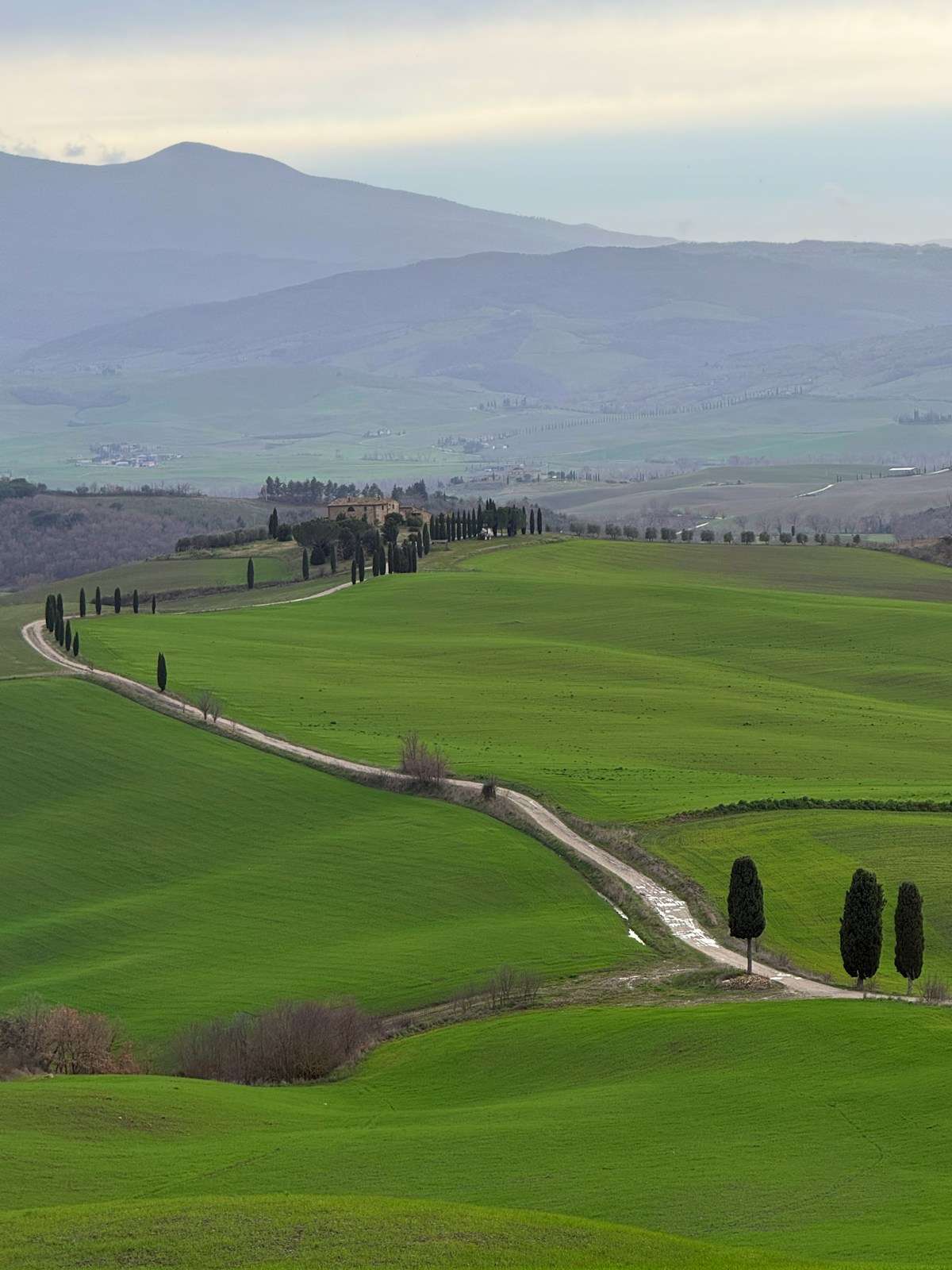
Val d’Orcia is a UNESCO World Heritage landscape in southern Tuscany — 2,000 square kilometres of pale clay hills (the crete senesi), cypress-lined farm tracks, medieval hilltop villages, Brunello di Montalcino vineyards, and thermal springs that have been used since Roman times. There is no single town that functions as a hub; the valley is a collection of villages — Pienza, Montalcino, San Quirico d’Orcia, Bagno Vignoni, Castiglione d’Orcia — each distinct, each surrounded by working farmland. Choosing where to stay is essentially choosing which part of the landscape you want to be closest to.
Search Val d’Orcia hotels on Booking.com to compare prices and check availability across all areas in this guide.
Pienza (Most Central Village)
Pienza is a Renaissance jewel — a model town commissioned by Pope Pius II in the 1460s and largely executed by the architect Bernardo Rossellino, compressed into a few streets on a ridge above the valley. The Piazza Pio II, the Duomo, and the bishop’s palace are all within 200 metres of each other. The main street (Corso Rosselino) is lined with cheese and wine shops selling the local Pecorino di Pienza, which is excellent. The town is small enough to walk in 20 minutes but has enough good restaurants and hotels to make it a comfortable multi-night base.
Pros: The most atmospheric and complete small town in the valley. Central location between Montalcino (25 km west) and Montepulciano (15 km east). Good restaurant choice for a town of this size. The views from the town walls south to Monte Amiata are exceptional.
Cons: Very small — limited services, no supermarket of any size, essentially one main street. Can feel crowded on summer weekends when day-tripper coaches arrive from Siena and Florence. Parking just outside the town gates is free but fills by mid-morning in peak season.
Budget (€70–100/night): Pienza’s B&B options are clustered in historic buildings along and just off Corso Rossellino. The B&B San Gregorio (Via della Madonnina): a quiet guesthouse in a converted stone building with views towards Monte Amiata; doubles from approximately €80/night as of 2026. Several private room rentals and small guesthouses offer doubles in the €70–90 range, typically with breakfast from the host.
Mid-range (€130–250/night): The Hotel Il Chiostro di Pienza (Corso Rossellino): a 4-star hotel in a 15th-century convent with a cloister, restaurant, and wine cellar; doubles from approximately €160/night in May as of 2026. This is Pienza’s most distinguished hotel and fills quickly. The Relais Il Chiostro and similar boutique properties in converted historic buildings offer good value at approximately €140–180/night.
Luxury (€280–500/night): The nearest true luxury options are agriturismi and country relais outside Pienza on the ridge road towards Montalcino. The La Bandita Townhouse (Corso Rossellino): a small boutique hotel with a rooftop terrace and pool; doubles from approximately €300/night in peak season as of 2026. Several farmhouse relais within 5 kilometres offer luxury-level accommodation with pool, spa, and panoramic views.
Montalcino (Best for Wine)
Montalcino is Brunello di Montalcino — one of Italy’s most important red wines, made from Sangiovese Grosso grown on the hillsides surrounding the town. The medieval fortress at the top of the hill has a wine bar serving multiple vintages by the glass; the enotecas on the main street offer extensive vertical tastings. Winery visits in the surrounding countryside (Biondi-Santi, Banfi, Casanova di Neri, Altesino) are the main draw, and several require advance reservation.
Pros: The best base for wine-focused visits. The fortress enoteca is one of the best wine experiences in Tuscany. Good town atmosphere with a genuine local community not solely dependent on tourism. Beautiful views south to Monte Amiata.
Cons: Fewer restaurant options than Pienza for non-wine dining. Less convenient for Monte Pulciano and eastern Val d’Orcia. Winery visits need to be booked ahead, particularly for the top estates.
Mid-range (€110–200/night): The Hotel Dei Capitani (Via Lapini): a 4-star in a historic building with a pool, wine cellar, and views over the Orcia valley; doubles from approximately €140/night in May as of 2026. The Palazzino di Corina (Via Soccorso Saloni): a boutique hotel in a 17th-century palazzo with a wine-focused restaurant; doubles from approximately €130/night.
Luxury (€250–450/night): Country relais in the Brunello zone outside Montalcino are among the most sought-after in Tuscany. Properties like the Castello Banfi — Il Borgo and similar estate hotels within the Brunello DOCG area command premium prices; doubles from approximately €280–450/night in peak season as of 2026, often including wine tasting and farm tours. These book out months ahead.
Bagno Vignoni (Thermal Baths Focus)
Bagno Vignoni is perhaps 30 families and a thermal pool — literally the piazza of the village is a Renaissance-era bathing pool fed by a sulphurous thermal spring at 52°C. There are a handful of hotels and a spa complex (Piscine Libere) where you can bathe in the thermal waters; these are the reason to come. The village is tiny but extraordinary, and staying here means you have access to the thermal facilities in the early morning before day visitors arrive.
Pros: Unique and deeply atmospheric — one of the most unusual villages in Italy. Direct access to thermal bathing. Very quiet in the evenings. The valley views from the pool terrace are exceptional.
Cons: Genuinely tiny — dining options are limited to the hotel restaurants and one or two trattorie. You need a car for everything else. Can be oppressively hot in summer (the thermal pool is less appealing in 35°C heat).
Mid-range to Luxury (€150–350/night): The Adler Thermae Spa & Relax Resort (Strada di Bagno Vignoni): the valley’s most complete spa hotel with multiple thermal pools, treatments, and a comprehensive wellness programme; doubles from approximately €250/night half-board as of 2026. The Hotel Le Terme (Piazza delle Sorgenti): directly on the historic thermal pool, with access to the spa; doubles from approximately €160/night. For this village, you are paying for the experience as much as the room.
Countryside Agriturismi
For many travellers, the point of Val d’Orcia is not any particular town but the landscape itself: the undulating pale hills, the isolated farmhouses visible for miles on cypress-lined ridges, the absolute quiet at night. An agriturismo in the countryside between the villages delivers this directly.
What to look for: Working farms with their own olive oil or wine production (Brunello, Rosso di Montalcino, or Orcia DOC). Stone farmhouse conversions with terracotta floors and exposed beams. A pool essential for summer stays. Look for properties between Pienza and Montalcino on the ridge road (SP88) for the classic Val d’Orcia view. Check that the agriturismo actually farms — some are essentially hotels that use the name.
Budget agriturismi (€80–120/night): Several family-run farms offer simple rooms with breakfast for approximately €85–100/night as of 2026. Facilities are basic but the location is often superb — and breakfast will typically include the farm’s own olive oil, cheese, and jam.
Mid-range agriturismi (€130–220/night): Properties with pools, en-suite bathrooms in converted stone buildings, and on-site restaurants with farm produce; from approximately €140–180/night. Examples include farms around Castiglione d’Orcia and on the ridge between Pienza and San Quirico.
Luxury relais (€280–600/night): The high end of Val d’Orcia farmhouse accommodation is genuinely world-class — restored medieval towers, private villa wings, infinity pools overlooking the valley, and in-house chefs. These properties represent some of the finest rural stays in Italy and book out for May, June, and September many months in advance.
Booking Tips for Val d’Orcia
A car is non-negotiable — book hire at Siena or Florence airports rather than a smaller station. May, late September, and October are the best months: the light, the colours, and the landscape are at their most photogenic. August is legal but hot, dry, and busier than you’d expect for countryside this remote. Agriturismi often require minimum 2-night stays; some have 3-night minimums in high season. Dinner at agriturismi usually requires advance reservation by mid-afternoon — confirm on arrival.
Search hotels and agriturismos in Val d’Orcia on Booking.com to compare properties and check availability across Pienza, Montalcino, and the surrounding hills.