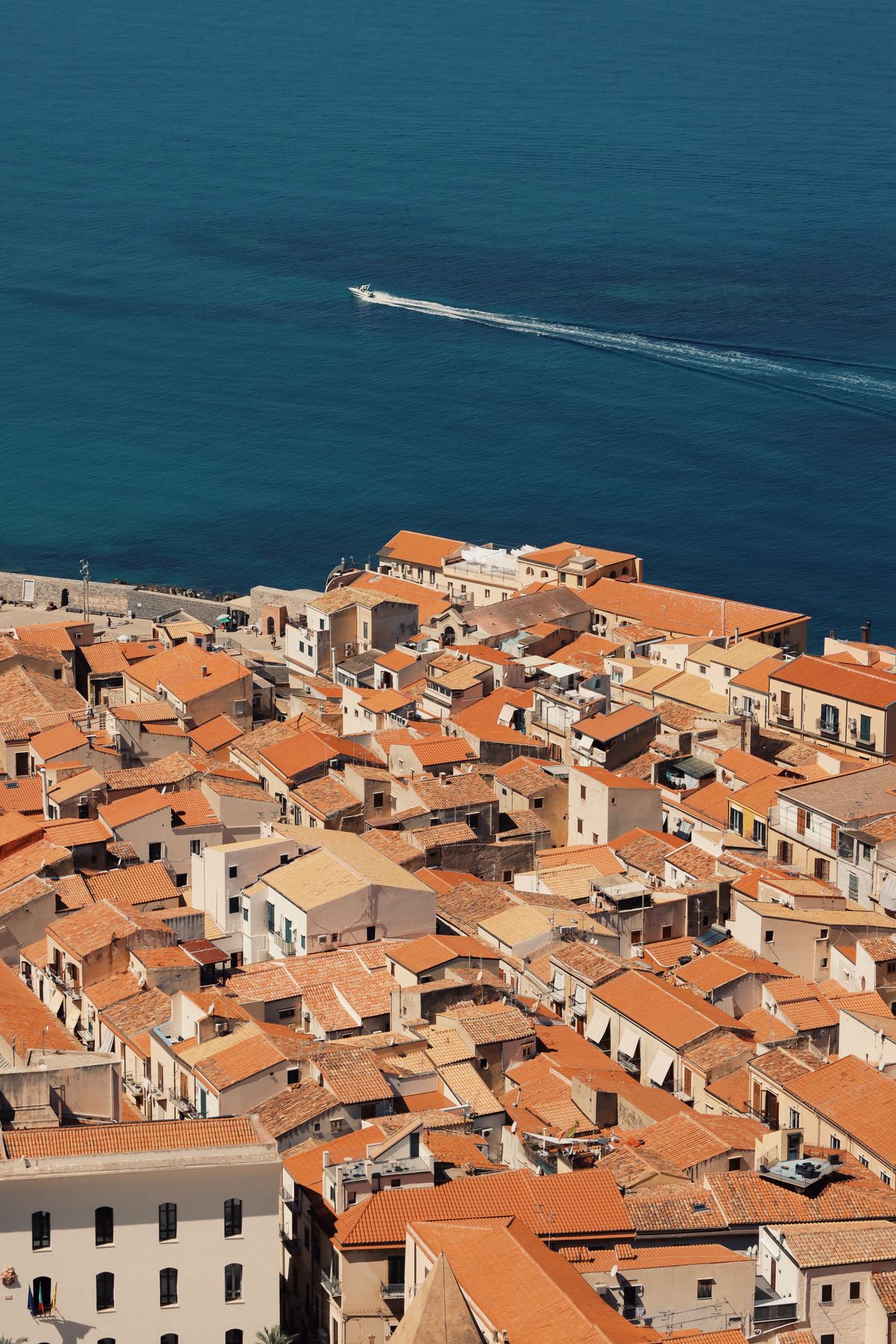
Syracuse was one of the most powerful Greek cities in the ancient Mediterranean — at its peak in the 4th century BC, it rivalled Athens in population and matched Carthage as a naval power. That history is visible everywhere: in the 5th-century BC Greek theatre, the Ear of Dionysius (a limestone cave with extraordinary acoustics), the Roman amphitheatre, and — most remarkably — the Duomo on Ortigia, whose interior columns are the original columns of the 5th-century BC Greek Temple of Athena, incorporated into the Christian cathedral in the 7th century AD.
The city today divides sharply between the modern mainland (commercial, utilitarian) and Ortigia — the small limestone island connected by bridge that holds the baroque historic centre. All accommodation of tourist interest is on Ortigia.
Search all Syracuse hotels on Booking.com to compare prices and availability across the areas in this guide.
Piazza del Duomo and the Centre of Ortigia
Piazza del Duomo is one of the finest baroque squares in Sicily — the Duomo (former Temple of Athena), the Palazzo Beneventano del Bosco, and the curved façade of Santa Lucia alla Badia line three sides of the sloping rectangular piazza. Hotels within a few minutes’ walk are at the heart of Ortigia’s best restaurants, the Fonte Aretusa spring, and the old market (Mercato di Ortigia) to the north.
Luxury (€200–350/night): Algila Ortigia Charme Hotel (Via Vittorio Veneto 93) occupies a 19th-century palazzo on the island’s eastern waterfront. Rooms have sea views over the Porto Piccolo; the rooftop terrace is one of the best vantage points on Ortigia. Thirty rooms, individually decorated with Sicilian ceramics and period furnishings. Doubles from approximately €200/night as of 2026; sea-view rooms from €260.
Mid-range (€130–200/night): Hotel Gutkowski (Lungomare Vittorini 26) is one of the best-known mid-range hotels in Sicily — a converted 20th-century building on the seafront of Ortigia, with 25 rooms, a sea-view terrace, and a deliberate local character that distinguishes it from generic boutique properties. Ask for a room facing the sea. Doubles from approximately €130/night as of 2026. Books well ahead from April–October; a genuine favourite rather than a marketing confection.
Budget (€85–130/night): Several B&Bs and small hotels operate in the residential streets of central Ortigia — Via Roma, Via Cavour, and the streets near the old market. Properties in this range typically offer 5–10 rooms in historic palazzo conversions, simple continental breakfasts, and honest prices. B&B dei Viaggiatori, Viandanti e Sognatori (Via Roma) is consistently well-reviewed for character and value. Doubles from approximately €90/night as of 2026.
The Northern End of Ortigia — Near the Market
The northern part of Ortigia, around the Mercato di Ortigia and the streets near Via Trento, is slightly less visited than the Duomo end but has the best street food and daily market produce. The Temple of Apollo — the oldest Greek Doric temple in Sicily — sits at the bridge entrance to the island. Hotels here tend to be a mix of boutique properties and converted historic buildings.
Boutique (€120–200/night): Residenza La Terrazza sul Mare and similar smaller residenze with rooftop terrace access and sea views operate in the northern part of the island. These smaller properties (typically 5–15 rooms) offer a more personal welcome than the larger hotels. Doubles from approximately €120/night as of 2026.
Marzamemi and the Southeastern Coast
For visitors using Syracuse as a base for exploring the Noto Baroque triangle (Noto, Ragusa, Modica are within 45–90 minutes) and the southeastern coast, options exist outside the city.
Coastal mid-range (€100–180/night): The fishing village of Marzamemi (60km south, 45 minutes by car) has small hotels and B&Bs that make a good base for beach days combined with baroque town visits. Alternatively, Lido di Noto (near Noto, 30km) has summer beach hotels. These work better for July–August beach holidays than for archaeology-focused visits.
Practical Notes
Greek Theatre and Parco Archeologico: The Parco Archeologico della Neapoli — 3km from Ortigia on the mainland — is non-negotiable. The Greek Theatre (Teatro Greco) is among the best-preserved in the world and hosts a classical drama season (May–June each year, Teatro Greco season). Arrive at opening time to beat the crowds; in summer, early morning is strongly recommended to avoid the worst heat.
Fonte Aretusa: The freshwater spring on Ortigia’s seafront, fed by an underground channel from the mainland. In Greek mythology, the nymph Arethusa was transformed here while escaping the river god Alpheus. Papyrus grows around the spring — one of the few natural papyrus habitats in Europe outside Africa.
Getting there: Syracuse (Siracusa) has its own train station on the mainland. Trains from Catania take approximately 1 hour 15 minutes (slow regional services — the line is not high-speed). From Palermo, change at Catania (total 3–4 hours). By car from Catania: 60km south on the A18/E45, about 1 hour.
Day trips: Noto (30km, 35 minutes by car) — Sicily’s most complete baroque city, rebuilt entirely after the 1693 earthquake. Ragusa and Ibla (90km, 1 hour 20 minutes). Modica (75km) — famous for its antique-style chocolate. The ancient quarries at Pantalica (40km) — a UNESCO-listed gorge with thousands of Bronze Age tombs.