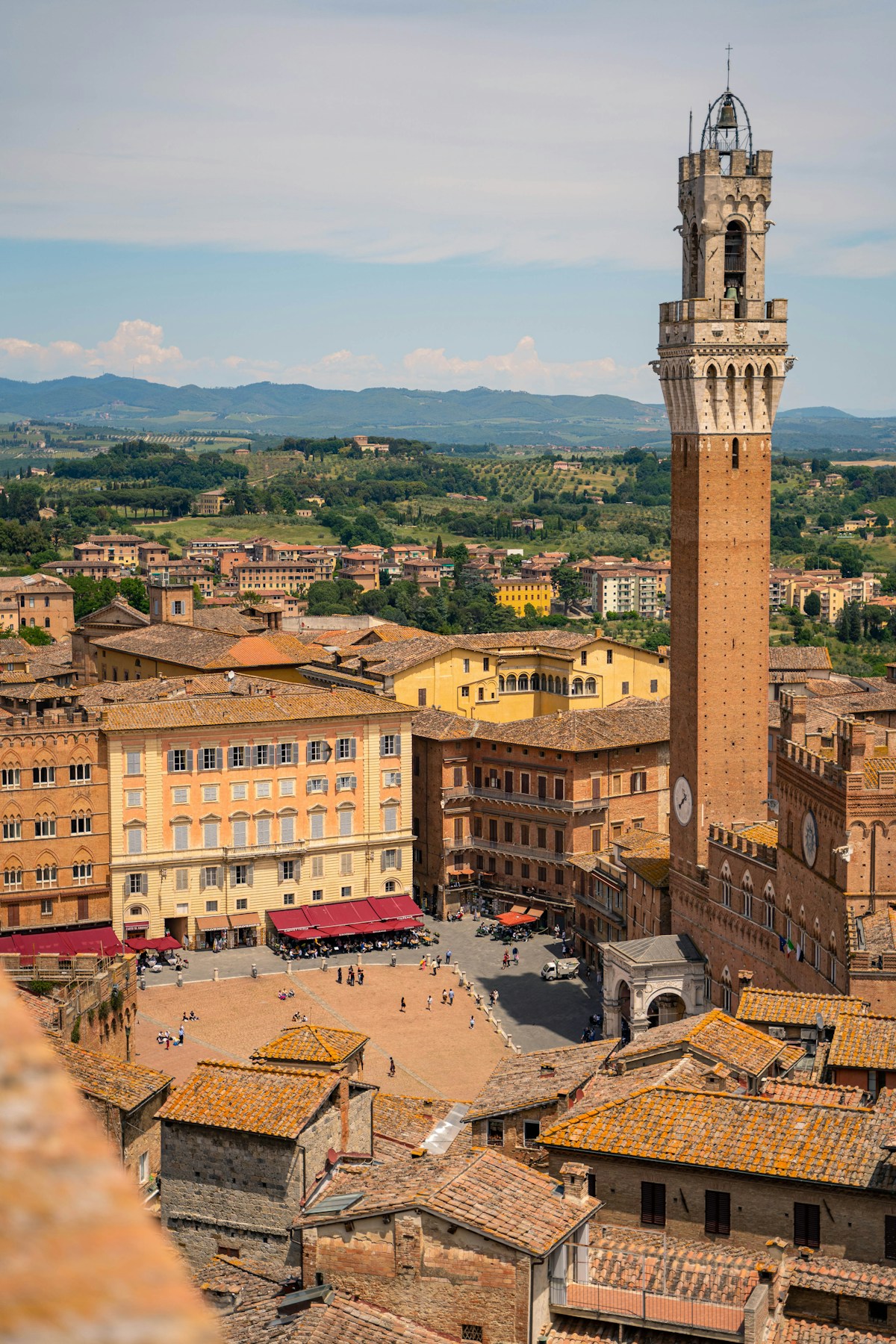
Siena is one of Italy’s most intact medieval cities, and staying here feels different from almost anywhere else in Tuscany. The entire historic centre is a UNESCO World Heritage Site, enclosed within walls that have changed little since the 14th century. The city divides into three historic thirds — the terzi — each with its own contrada associations and character, but all converging on Il Campo, the extraordinary shell-shaped piazza that functions as the city’s living room at every hour of the day.
The practical reality of staying in Siena is this: the best experience is inside the walls, but getting there requires navigating the ZTL (Zona a Traffico Limitato). Hotels inside the centre can arrange permits for driving in, but all arrivals need pre-registration. Most visitors find the process straightforward once they know to ask. Alternatively, Siena has large car parks (Il Campo P1 and P2, La Lizza) just outside the walls, and the centre is a short uphill walk from any of them.
Search all Siena hotels on Booking.com to compare prices and availability across the areas in this guide.
Around Il Campo and Via Banchi di Sopra
The spine of Siena’s commercial and social life runs along Via Banchi di Sopra from Il Campo north towards Piazza Salimbeni. Hotels along or near this route are as central as it gets — Il Campo is at most a five-minute walk from any address on this stretch, and the main Duomo complex is reachable in under fifteen. This zone has the highest concentration of four- and five-star hotels in the city, alongside good options at the lower end.
Luxury (€250–450/night): The Grand Hotel Continental (Via Banchi di Sopra 85) is the historic flagship of Siena accommodation, set in a 17th-century palazzo built for the Chigi family. Frescoed ceilings survive in several common areas, and the breakfast — served in the original ballroom in cooler months and on the terrace in summer — is widely considered the best in the city. Doubles from approximately €250/night as of 2026; suites from €400. For a special occasion or a first visit to Siena, this is the address.
Mid-range (€130–200/night): Several well-regarded three- and four-star hotels operate on the side streets feeding off Via Banchi di Sopra. Options in this price band typically occupy converted historic buildings with en-suite rooms, buffet breakfasts, and concierge services capable of managing ZTL permits without friction.
Around the Duomo and Pian dei Mantellini
The Terzo di Città — the southwest section of the historic centre — contains the Duomo di Siena, Santa Maria della Scala museum, and some of the quietest streets within the walls. This area is marginally less busy than the Campo zone, and the character is more residential. It suits visitors who want to spend time around the Duomo complex and the Pinacoteca Nazionale rather than the commercial spine.
Mid-range (€110–200/night): Palazzo Ravizza (Pian dei Mantellini 34) has been a family-run hotel since 1922. The building dates from the Renaissance and retains much of its original character — stone floors, painted ceilings in some rooms, and a walled garden with views over the Tuscan countryside. Doubles from approximately €115/night as of 2026; rooms with garden views command a small premium. Reviews consistently praise the sense of stepping into a private residence rather than a hotel. Book well ahead for summer.
Budget (€70–100/night): The Hotel Alma Domus (Via Camporegio 37), set in a 13th-century building near the Basilica di San Domenico, is run by nuns and offers clean, simple rooms at honest prices. It lacks the frills of larger hotels but the location is excellent — San Domenico is a 10-minute walk from Il Campo, and the views from the terrace down into the Fontebranda valley are striking. Doubles from approximately €75/night as of 2026.
Terzo di San Martino — East of Il Campo
The eastern third of the city is the quietest of the three terzi and the most residential. Streets here are narrower and steeper, and the tourist footprint is lighter than in the Campo or Duomo zones. The Orto de’ Pecci — a working medieval garden at the bottom of a natural bowl just inside the walls — is one of Siena’s most unexpected spaces. This area suits independent travellers who want authentic neighbourhood life alongside the major sights.
Boutique (€140–250/night): Campo Regio Relais (Via della Sapienza 25) occupies a pair of 16th-century buildings with views directly towards the Duomo from several rooms and the terrace. Six individually decorated rooms, no restaurant but a breakfast service. Doubles from approximately €150/night as of 2026; worth checking for last-minute availability.
Mid-range: Several smaller three-star hotels and B&Bs operate on the side streets of this terzo. Look for options on Via di Pantaneto and Via San Martino — both are quiet in the evenings and well placed for exploring the city’s eastern neighbourhoods.
Just Outside the Walls
The area immediately outside Siena’s walls — accessible from the Porta Camollia to the north and Porta Romana to the south — offers hotel options that cost significantly less than equivalent properties inside. The trade-off is a short walk to the historic centre (typically 10–20 minutes from most external hotels), but for visitors with cars, parking is straightforward at the large car parks on the western side.
Budget to mid-range (€75–140/night): Albergo Chiusarelli (Viale Curtatone 15) sits just outside the walls to the north, a 10-minute walk from Il Campo via Porta Fontebranda or the longer route through Porta Camollia. The Neoclassical building dates from the 19th century and the hotel has been renovated to a clean, functional standard. Doubles from approximately €80/night as of 2026. The location is useful for arriving by bus — the main terminal is a short walk away — and the surrounding park (Il Ravacciano) is pleasant for morning walks.
Agriturismo and countryside (€100–300/night): For visitors with cars, the Chianti landscape around Siena is scattered with agriturismi and country-house hotels within 15–30 minutes of the city. Several villa hotels and converted farmhouses operate in the Crete Senesi to the south and the Chianti hills to the north. These suit visitors combining Siena with a Tuscany driving circuit rather than those relying solely on the historic centre.
Practical Notes
ZTL access: All hotels inside the walls should be able to issue a permit code for your vehicle registration. Contact your hotel at least 48 hours before arrival, confirm your plate number, and clarify the time window for entering. Fines arrive by post and the system is fully automated — the process is straightforward if you follow it.
Parking: The main paid car parks are Il Campo P1 (near Piazza Gramsci), Il Campo P2, and La Lizza (below the fortress). All are outside the ZTL and a 10–20 minute walk from the central attractions.
Palio dates: 2 July and 16 August. If your visit coincides with the Palio, book accommodation at least 3 months ahead. The race itself lasts under 90 seconds but the build-up begins days before, and the city fills to capacity. Minimum stays of 2–3 nights are standard during Palio week.
Day trips: Siena works well as a base for San Gimignano (30km, about 45 minutes by bus), Montepulciano (65km), and Montalcino (40km). The train to Florence takes approximately 1 hour 30 minutes; buses to Florence take approximately 1 hour 15 minutes via the fast Siena–Florence route.