Pienza is unlike any other town in Tuscany because it was designed rather than evolved. In the 1460s, Pope Pius II — born Enea Silvio Piccolomini, in the village of Corsignano that would become Pienza — commissioned the Florentine architect Bernardo Rossellino to build an ideal Renaissance city on the site of his birthplace. Rossellino completed the central piazza, Duomo, and surrounding palazzi in under a decade. The result is a town plan of exceptional coherence: Piazza Pio II, framed by the Duomo, the Bishop’s Palace, the Palazzo Piccolomini, and the town hall, is one of the most complete Renaissance urban set-pieces in existence.
The town is tiny. There are perhaps 200 metres of main street (Corso Rossellino), a few parallel lanes, and the ramparts facing south over the Val d’Orcia. Accommodation is correspondingly limited — Pienza has fewer hotels than most small neighbourhoods in Florence, and booking ahead is essential from April through October.
Search all Pienza hotels on Booking.com to compare prices and availability across the areas in this guide.
Inside the Historic Centre
Everything in Pienza’s old town is within a few minutes’ walk of Piazza Pio II. The distinction between “central” and “less central” accommodation barely applies here — the town is small enough that all in-town properties are effectively equivalent in terms of proximity to the main sights.
Luxury (€180–300/night): Il Chiostro di Pienza (Corso Rossellino 26) occupies a converted 15th-century convent with a central cloister garden. The 37-room hotel is the most substantial property in Pienza’s historic centre. The former convent cells have become guest rooms retaining stone walls and vaulted ceilings; several face the cloister garden, others the Val d’Orcia or the town streets. Restaurant on site. Doubles from approximately €180/night as of 2026.
Mid-range (€120–180/night): La Bandita Townhouse (Corso Rossellino 111) is a nine-room boutique hotel at the western end of Corso Rossellino. The aesthetic skews contemporary within a historic structure — less medieval palazzo, more considered Italian design. Known for a well-regarded restaurant and a relaxed atmosphere that sets it apart from more formal properties. Doubles from approximately €130/night as of 2026.
Budget (€80–120/night): Small B&Bs and affittacamere (room rentals) in Pienza’s backstreets offer the most affordable in-town accommodation. Options here typically involve a local family renting out two or three rooms — no restaurant, basic breakfast, and a very personal welcome. These book quickly from April through September. Search for options on Via della Resistenza and the streets behind Corso Rossellino.
Outside the Walls — Immediately Adjacent
A few properties sit just outside Pienza’s gates, offering parking and slightly lower rates than in-town equivalents. The walk from Porta al Prato (the main east gate) to Piazza Pio II takes about 5 minutes. These properties work well for visitors arriving by car.
Mid-range (€100–160/night): Hotel Relais Il Chiasso and similar small relais properties near the town gates offer rooms with private parking, a significant practical advantage in a town where in-town parking is essentially nonexistent. Doubles from approximately €100/night as of 2026.
Val d’Orcia Countryside — Agriturismi and Villa Hotels
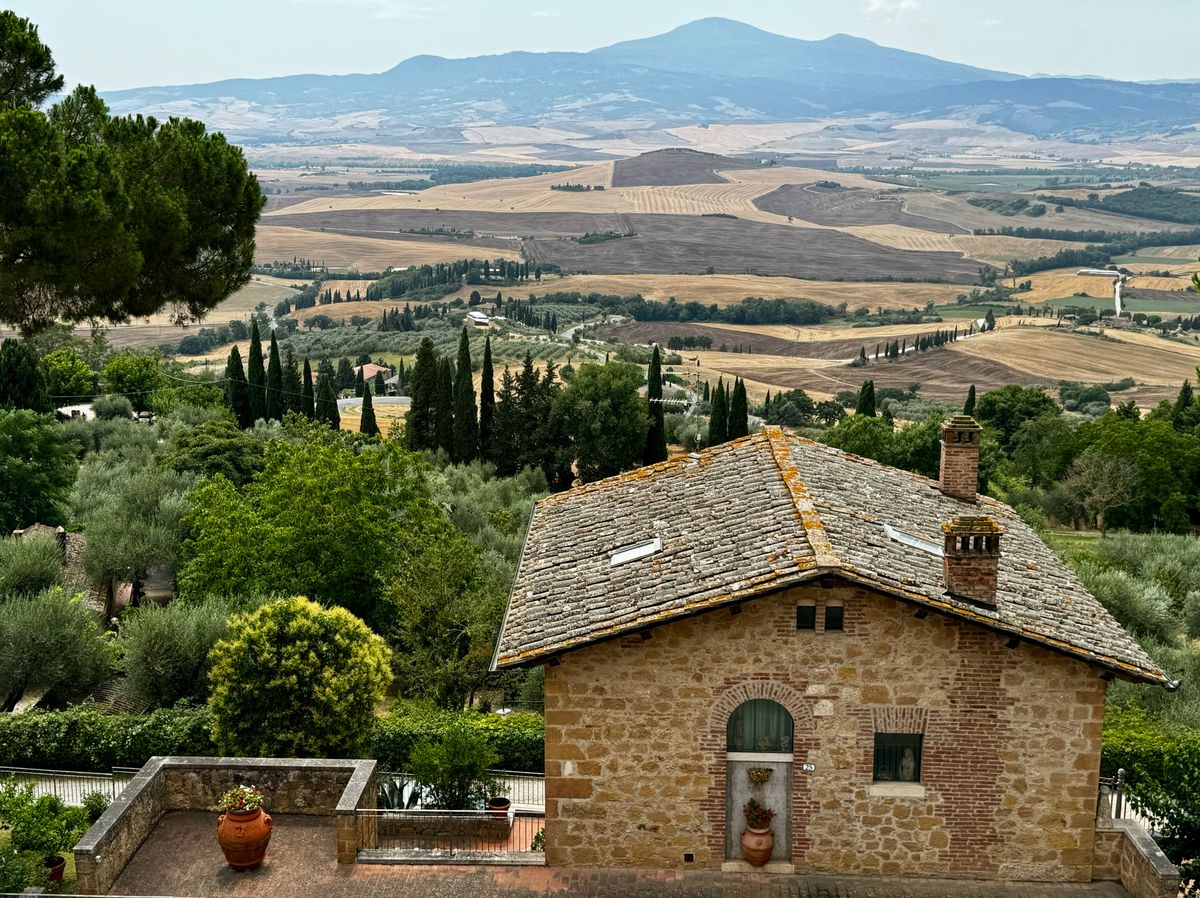
The countryside around Pienza — the Val d’Orcia, a UNESCO World Heritage landscape — is widely considered the most beautiful agricultural landscape in Italy. Cypress-lined lanes, medieval farmhouses, and the distinctive rolling hills known as the crete senesi extend in all directions. For visitors with cars, a countryside stay is often preferable to the very limited in-town options, particularly for stays of more than two nights.
Luxury (€200–450/night): Several high-end country house hotels operate within 10–20km of Pienza. Agriturismo Terrapille (Podere di Terrapille) is one of the most photographed farmhouses in the Val d’Orcia — the cypress avenue leading to the house appears on the covers of countless Tuscany books. The property accepts guests in a handful of apartments and rooms, pool on site, surrounded by working farmland. Doubles from approximately €200/night as of 2026 (high season; book months in advance).
Mid-range farmstay (€100–180/night): The road between Pienza and Montalcino (SP14) passes through prime agriturismo country. Properties along this route typically offer rooms or self-catering units with vineyards or wheat fields as the backdrop, a pool, and breakfasts using estate produce.
Practical Notes
Parking: There is no practical parking inside Pienza’s historic centre. The main car park is just outside Porta al Murello (south side) and Porta Grassi (east side). Both are a short walk from Corso Rossellino.
Val d’Orcia viewpoints: The classic Val d’Orcia view — rolling hills with a solitary cypress — is found along the SP146 between Pienza and San Quirico d’Orcia (10km west). This road is particularly beautiful in late spring (green fields and flowering poppies) and early summer (golden wheat before harvest). Most photographers aim for early morning or the hour before sunset.
Day trips: Montepulciano is 15km east (20 minutes by car), Montalcino is 30km northwest (35 minutes). Bagno Vignoni, a thermal spring village, is 10km west. The abbey of Sant’Antimo near Montalcino is under 45 minutes. The entire Val d’Orcia is manageable as a half-day circuit.
Pecorino shopping: The best range of Pecorino di Pienza is at the shops on Corso Rossellino — look for Buon Gusto (n° 6) and the various cheese shops between the town gates and the piazza. Aged varieties wrapped in walnut leaves or submerged in Vino Nobile are local specialities.