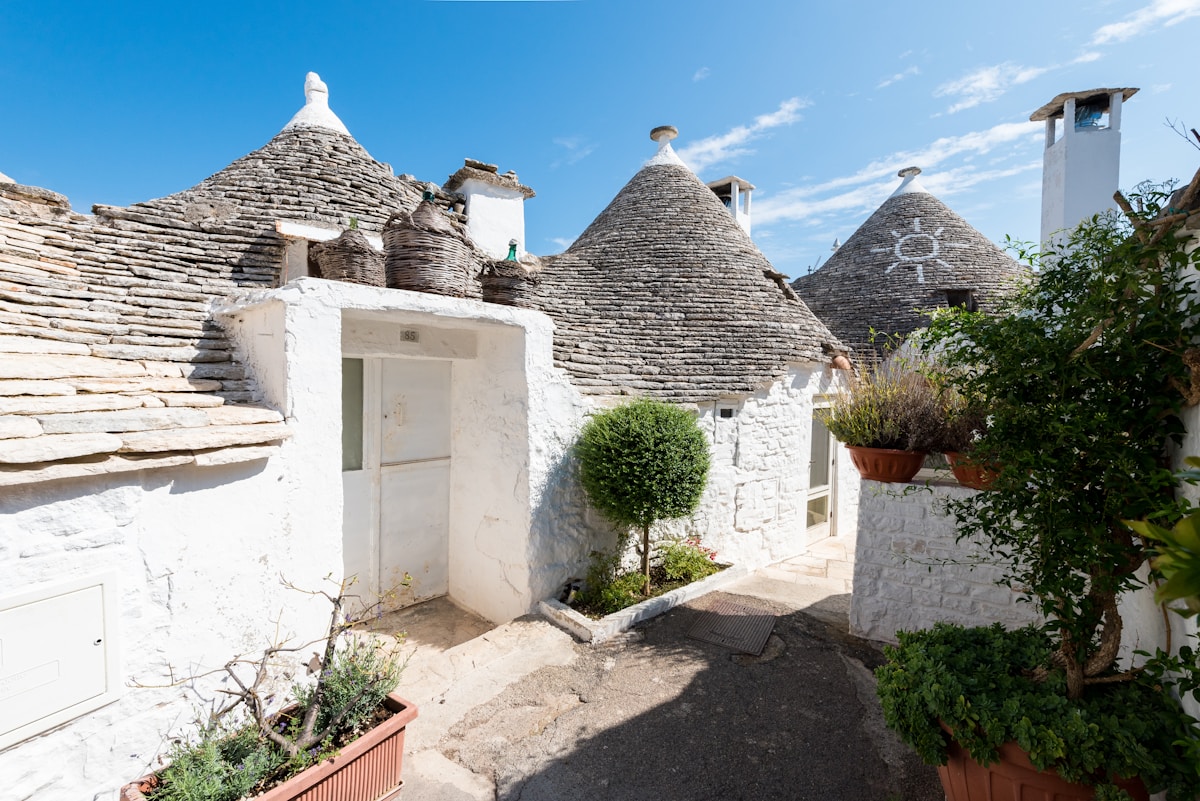
Alberobello is built on an unusual premise: an entire town of conical stone buildings — trulli — that have survived intact because, according to local history, they were designed to be easily dismantled when royal inspectors approached to avoid taxation. The result is a UNESCO World Heritage Site of extraordinary consistency: Rione Monti alone has over a thousand whitewashed trulli stacked up the hillside, their grey limestone cones painted with symbolic patterns. It’s one of the most distinctive townscapes in Italy, and staying here rather than day-tripping from Bari or Lecce changes the experience entirely.
Search Alberobello hotels on Booking.com to compare prices and check availability across all areas in this guide.
Rione Monti — The Main Trulli District
Rione Monti is the larger of Alberobello’s two trulli zones: hundreds of whitewashed cones covering a hillside directly east of the town centre. By day it’s the busiest part of Alberobello — every ground floor is a souvenir shop or café. By night, after the buses leave, it becomes a very different place.
Accommodation here: Many trulli in Rione Monti are registered accommodation. Self-catering options predominate — you book a trullo (or a cluster of trulli connected internally) directly, typically through Booking.com or local agencies. Standards have improved considerably over the past decade; expect modern bathrooms and properly fitted kitchens in the better properties.
Budget trulli (€80–130/night): Simpler two-room trulli with basic but functional fittings. Some are converted ground-floor structures with the cone ceiling as the main feature. Adequate for two people; check recent reviews for specifics on plumbing and mattress quality before booking.
Mid-range trulli (€130–220/night): Properly restored single or multi-cone trulli with quality furnishings, modern bathrooms, air-conditioning (essential in July–August), and often a small terrace or garden. Trulli Smeraldo and Eco del Trullo are among the better-established names in this bracket as of 2026.
Luxury end (€220–400/night): Large trulli complexes — multiple connected cones, a private garden, quality kitchens, and period character — are available for 2–6 guests. These work particularly well for couples or small groups wanting a private base. Check aggregator platforms in the three to four months before your trip: best properties book up well before high season.
Aia Piccola
Alberobello’s smaller trulli district is a short walk from Rione Monti and considerably quieter. It’s a genuine residential neighbourhood where locals still live — the tourist concentration is far lower. Accommodation options are fewer but the atmosphere is more authentic.
What to expect: Simpler, often family-run trulli guesthouses at slightly lower prices than the main tourist zone. Less walking-distance infrastructure (fewer restaurants on the doorstep), but the peacefulness is notable.
Rates: Approximately €70–150/night for self-catering options as of 2026. Some rooms available in family homes.
Valle d’Itria — Masseria Resorts
The broader valley around Alberobello — roughly a 15–30 minute drive in any direction — has a concentration of luxury masseria (fortified farmhouse) hotels and countryside trulli complexes that offer a different kind of Puglia stay.
Pros: More space, pools, countryside views, typically good on-site restaurants. The best masseria in the Valle d’Itria are among the finest rural hotels in Italy.
Cons: Car essential. Alberobello itself is a 15–30 minute drive. You’re trading direct access for tranquillity and facilities.
Top end: Masseria Il Frantoio (near Ostuni) and various properties near Fasano, Locorotondo, and Martina Franca represent the premium end; nightly rates from approximately €200–500+ as of 2026. For the Alberobello area specifically, look at Locorotondo (10 km north) as a base — a beautiful hilltop white town with its own accommodation and a slightly less crowded atmosphere.
Plan your trip:
- Browse Puglia tours from Alberobello
- Book an airport transfer
- Get travel insurance for Italy
- Pick up an eSIM for Italy
- Search hotels in Alberobello on Booking.com
Practical notes
- Book early for summer. July and August are peak season; the better trulli book up 3–4 months in advance. Spring (April–May) and autumn (September–October) are the best times — pleasant temperatures, lower prices, manageable crowds.
- Two nights minimum recommended. Alberobello is compact enough to see in a day, but the evening and early morning atmosphere — once tour groups have gone — is when the trulli are most rewarding. One night is a gateway; two nights gives you the whole experience.
- Car strongly recommended. Alberobello is reachable by train from Bari (FAL Ferrovie del Sud-Est line), but the surrounding Valle d’Itria requires a car. Most visitors base themselves in Alberobello and make day trips to Locorotondo, Ostuni, Polignano a Mare, and Matera.
- Air conditioning matters. July and August are very hot in Puglia (35°C+). Trulli with thick stone walls stay cooler than regular buildings, but air conditioning in the sleeping area is worth confirming before booking.
The Alberobello travel guide covers the UNESCO trulli circuit, the history of the cone buildings, and the town’s best restaurants and things to do.