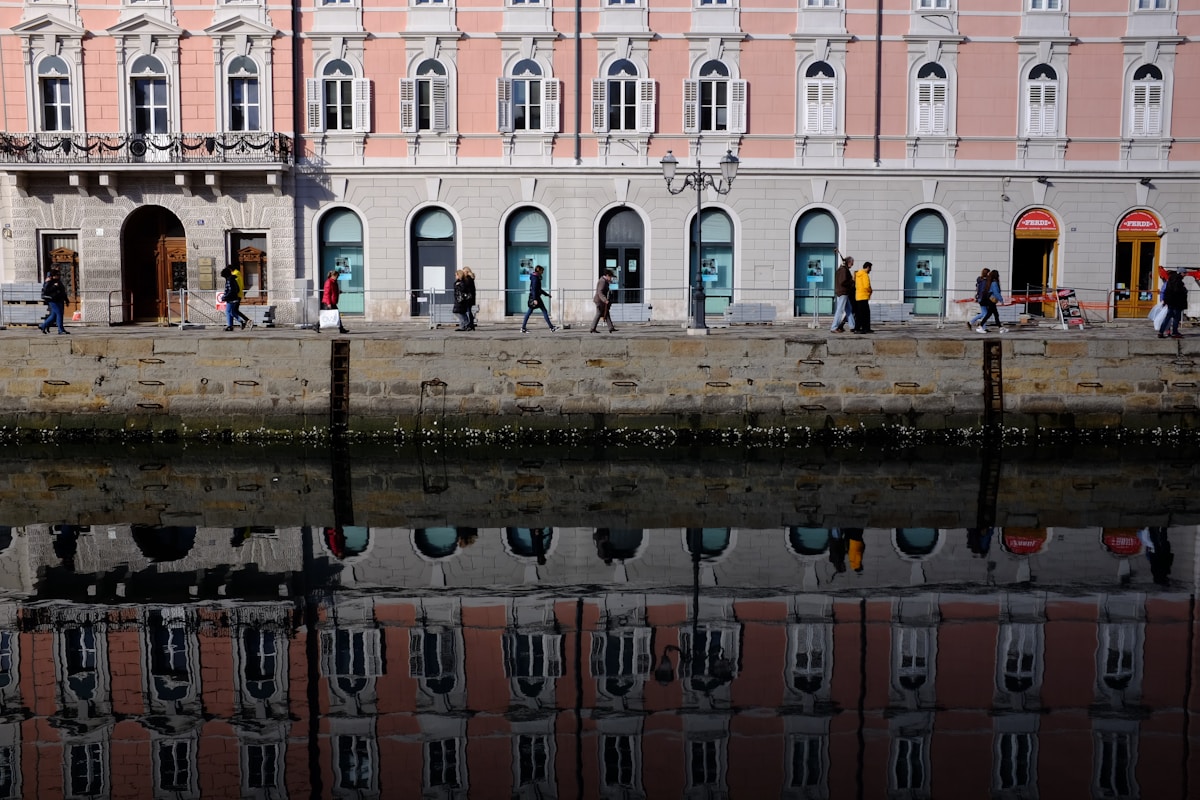
Trieste Travel Guide: Italy's Edge City on the Adriatic
Trieste travel guide: Habsburg port city on Italy's northeastern edge, with Miramare Castle, Piazza Unità, James Joyce's city, and Italy's best coffee.
Guides for Trieste
Trieste is Italy’s most unusual city - a Habsburg port that was part of the Austro-Hungarian Empire until 1918, with a Central European character unlike anywhere else in Italy. The city has three overlapping identities: Italian (the language and the people), Austro-Hungarian (the grand 19th-century architecture, the coffee culture, the literature), and Slovenian (the border is 5km from the centre). James Joyce lived here for a decade and wrote much of Ulysses in Trieste’s cafes. Italo Svevo, one of the 20th century’s great novelists, was from here.
The city
Piazza Unità d’Italia - One of the largest piazzas in Italy opening onto the sea - one side faces the Gulf of Trieste rather than another building. The Palazzo del Municipio and the Palazzo del Lloyd Triestino give the square its grand Austrian character. In the evening, the square is illuminated and the waterfront passeggiata begins. The scale of the piazza, with the sea beyond, is unlike anything else in Italy.
Castello di San Giusto (Piazzale Castello) - The 15th-century castle above the city, on the hill where the Roman forum stood. Houses a weapons museum and provides panoramic views over the city and gulf. Entry approximately €5 as of 2026. Open daily 10am–7pm (summer), 10am–5pm (winter). The nearby Cathedral of San Giusto has 12th-century mosaics in the Byzantine style - a reminder that Trieste was long a border between Western and Eastern Christendom.
The old city (Città Vecchia) - The medieval quarter on the hill between the castle and the waterfront. Narrow lanes, staircases, small churches, and a character distinct from the grand Austro-Hungarian grid below.
Miramare Castle (Viale Miramare) - 8km from the centre on a wooded headland above the sea. The 19th-century castle built for Archduke Maximilian of Austria (who became Emperor Maximilian I of Mexico and was executed in 1867) has lavishly furnished interiors and extensive formal gardens. Castle entry approximately €10 as of 2026. Gardens free. Open daily 9am–7pm (summer), 9am–5pm (winter). Accessible by bus 36 from Piazza Oberdan (approximately 20 minutes, approximately €1.35) or by the coastal path (approximately 1.5 hours on foot from the centre).
Risiera di San Sabba (Via Giovanni Palatucci 5) - A former rice-husking factory used as a Nazi concentration camp during WWII - the only camp with a crematorium in Italy. Now a national monument and museum. Free entry. Open daily. A sobering and important site.
Coffee
Trieste has the most intense coffee culture in Italy - the port handles approximately 40% of Italy’s coffee imports. The city is the headquarters of Illy. Coffee is ordered differently here than elsewhere in Italy: a capo (equivalent to a macchiato), a nero (straight espresso), a capo in b (macchiato in a glass). The vocabulary is unique to Trieste.
Historic cafes: Caffè degli Specchi (Piazza Unità d’Italia - espresso approximately €1.50) has the finest terrace in the city. Caffè San Marco (Via Battisti 18) is a literary cafe where Joyce, Svevo, and Umberto Saba drank - the interior is wood-panelled, serious, and atmospheric. Caffè Tommaseo (Piazza Tommaseo 4) is the oldest cafe in Trieste (1830).
Where to eat
Trieste’s cuisine reflects its mixed heritage: jota (bean and sauerkraut soup - Central European), strucolo (strudel), goulash alongside Italian pasta and seafood. Buffet da Pepi (Via della Cassa di Risparmio 3 - a Triestine institution since 1897, boiled pork and sausages from approximately €8) and Buffet Siora Rosa (Piazza Hortis 3) serve the traditional Trieste buffet - a counter-service format unique to the city. Trattoria Nerodiseppia (Via Cadorna 11 - seafood, mains approximately €14–18) is excellent for Adriatic fish.
Where to stay
Budget: approximately €50–80/night near the station or in the old city. Mid-range: approximately €80–140/night. Hotel Filoxenia (Via Mazzini 22 - doubles from approximately €85/night) is centrally located. Savoia Excelsior Palace (Riva del Mandracchio 4 - doubles from approximately €150/night) faces the waterfront with views across the Gulf.
Getting there
Trieste Centrale station: trains to Venice approximately 2 hours (from approximately €15), to Ljubljana (Slovenia) approximately 2 hours (from approximately €12), to Vienna approximately 6.5 hours. Trieste Airport (TRS) has limited European connections; Venice Marco Polo Airport (approximately 1.5 hours by bus) is the more practical arrival point for international flights.
Practical details
Getting around the city: The historic centre is walkable. The tram of Opicina - a hybrid funicular-tramway that climbs from the city to the Karst plateau above - was closed for restoration as of 2026; check its status before visiting (it’s one of the more unusual experiences in the region when operating). City bus tickets approximately €1.35.
The Karst plateau: Immediately above Trieste, the Carso (Karst) is the limestone plateau that gives its name to karst geology worldwide. It’s riddled with sinkholes and caves - the Grotta Gigante (Borgo Grotta Gigante, approximately 12km from the centre) is one of the largest accessible cave chambers in the world. Guided tours hourly (approximately €14 entry, approximately 50 minutes). Accessible by bus 42 from Trieste (approximately 30 minutes, approximately €1.35). The plateau itself is good hiking country, with village trails and views over the Gulf of Trieste.
Accommodation: Trieste’s hotel market is less expensive than Venice or Bologna. Budget: approximately €50–80/night near the station or along the lower city streets. Mid-range: approximately €80–140/night. Hotel Filoxenia (Via Mazzini 22 - doubles from approximately €85/night as of 2026) is centrally located, close to Piazza Unità d’Italia. Urban Hotel Design (Androna Chiusa 4 - doubles from approximately €100/night) is a boutique option in the old city. Savoia Excelsior Palace (Riva del Mandracchio 4 - doubles from approximately €150/night) faces the waterfront - the best view in Trieste, at a price.
Practical food tip: The traditional Triestine buffet (counter-service boiled pork, sausages, and bread) at Buffet da Pepi operates from approximately 8:30am–3pm and 5pm–9pm - it’s not dinner service in the traditional sense but a lunch-and-early-evening institution. A full plate with wine costs approximately €12–15. Queues are normal and worth it.
For accommodation: Trieste hotels. For Miramare Castle, the Grotta Gigante, and the café literary circuit: things to do in Trieste. Book a guided Trieste tour to explore the Habsburg waterfront, the literary cafes, and Miramare Castle with a local expert. For the Triestine food tradition - jota, prosciutto cotto, and the buffet culture: Trieste food guide. Trieste is 2 hours from Venice and a natural extension on a northern Italy itinerary.
Upcoming Events in Trieste
La Befana - Feast of the Epiphany 2027
La Befana 2027, January 6. Italy's Epiphany gift-giving day: children receive sweets or coal from the Befana witch, then decorations come down.
Book an experience
Top experiences in Trieste
Explore the best tours and activities in Trieste, with instant confirmation and free cancellation on most bookings.