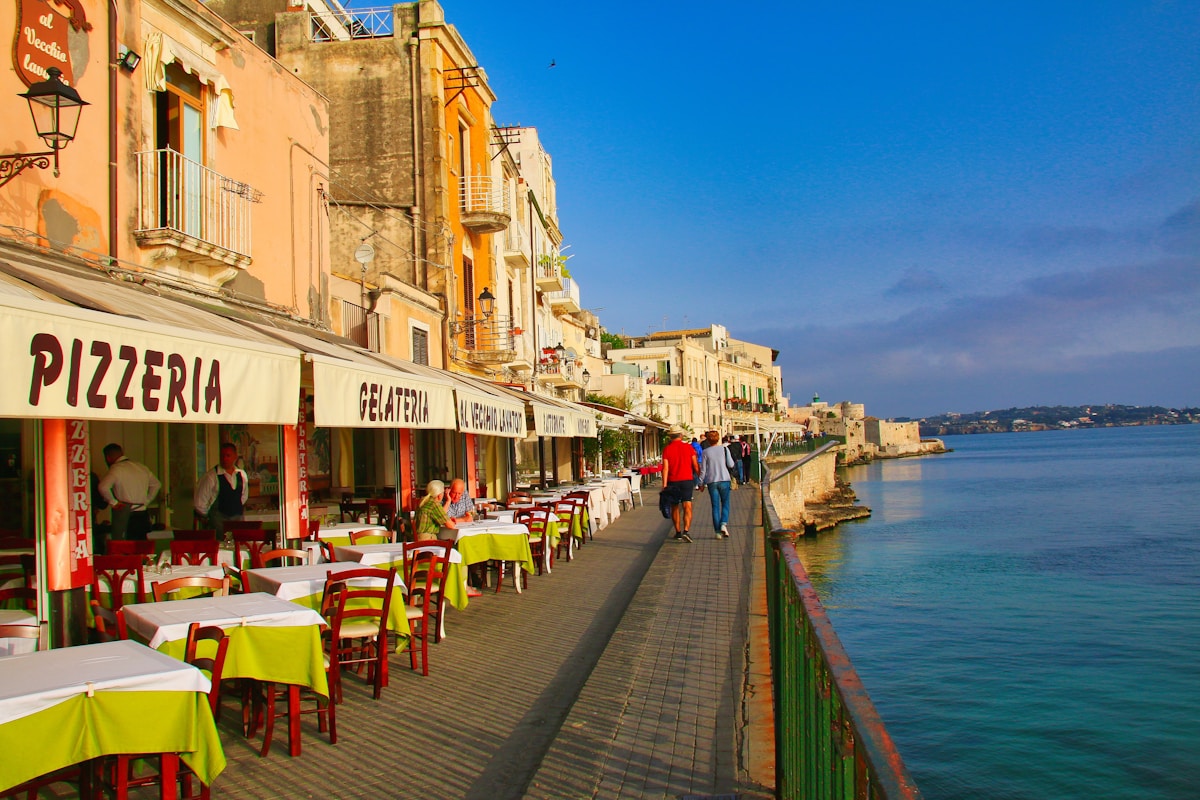
Sicilian food is the most distinctive regional cuisine in Italy - a layered product of the island’s Greek, Arab, Norman, and Spanish occupants, each of whom left traces in the ingredients, techniques, and flavour profiles. Taormina, as eastern Sicily’s main tourist hub, presents a version of this food that ranges from excellent (fresh swordfish, proper granita, real arancini) to aggressively mediocre (tourist-menu pasta at Corso prices). Knowing the difference before you order matters.
Granita con Brioche
The defining Sicilian food experience - and the best reason to be at a Taormina bar at 8am. Granita is not a slushie: a proper version is made by repeatedly scraping a semi-frozen mixture during the freezing process, creating a texture that’s simultaneously crystalline and smooth. The traditional flavours of eastern Sicily are:
Caffè - strong espresso granita, served with or without panna (fresh whipped cream) Mandorla - almond, made from Sicilian almonds, with a milky richness Limone - sharp and refreshing, the simplest and most unforgiving (a poor-quality lemon is immediately obvious) Pistacchio di Bronte - pistachio from the Bronte area near Etna, with a distinctive green colour and earthy sweetness; the most expensive and often the best
The brioche arrives warm, slightly sweet, and domed - to be torn and dipped into the granita.
Bar Bam Bar (Via Giovanni di Giovanni 45) makes granita from scratch daily and is consistently cited as the best in Taormina. A granita with brioche costs approximately €3–4.50 as of 2026 depending on flavour.
Caffè del Corso (Corso Umberto) is the most central option - reliable quality, slightly higher prices given the location.
Pasta alla Norma
Fried aubergine, fresh tomato sauce, ricotta salata (salted, dried ricotta), and basil - the combination was so good when it was first served in Catania that someone said it was like Bellini’s Norma. For a dish to be made properly, each element must be separately cooked:
- The aubergine must be fried, not roasted (different flavour and texture)
- The tomato sauce should be fresh and slightly sweet
- The ricotta salata should be salty and firm enough to grate
- The basil should be added at the end, not cooked
Trattoria da Nino (Via Luigi Pirandello 37) has been serving this and other Sicilian classics since 1969. The pasta alla Norma is approximately €12; the fish dishes approximately €18–25. It’s a tourist restaurant in the honest sense - visited mainly by visitors - but the kitchen maintains standards.
Arancini
Sicilian fried rice balls - one of the great street foods. The filling varies by tradition:
Arancino al ragù (the Palermo style, using masculine form arancino) - meat ragù with tomato and peas Arancina al burro (Palermo style) - butter, mozzarella, and sometimes ham Arancino al pistacchio (eastern Sicily) - pistachio and mozzarella, the version most common in Taormina
The quality difference between a good arancino (crisp exterior, distinct filling, well-seasoned rice) and a poor one (soggy, uniform interior, under-seasoned) is significant. Bakeries and rosticcerie make them fresh in the morning; by afternoon they’re reheated at best.
Bam Bar (as above) also makes excellent arancini alongside the granita.
Rosticceria Taormina (Via Di Giovanni) sells them directly from the fryer from around 8am - approximately €2–3 each as of 2026.
Swordfish (Pesce Spada)
The Strait of Messina between Sicily and Calabria is one of the prime swordfish fishing grounds in the Mediterranean - the current where the Ionian and Tyrrhenian seas meet concentrates the fish. Swordfish caught in the Strait (pesce spada dello Stretto) is significantly better than the imported frozen product that appears in the cheaper tourist restaurants.
Involtini di pesce spada - swordfish rolled around a filling of breadcrumbs, capers, pine nuts, and raisins (the Arab-Sicilian sweet-sour combination called agrodolce), grilled. This is the cooking technique for swordfish at its best: the filling absorbs the fish oils during grilling, and the exterior caramelises slightly.
Al Saraceno (Via Circonvallazione 8) is a reliable kitchen for swordfish and other Strait-caught fish, at prices below the main Corso restaurants. Fish dishes approximately €18–25 as of 2026.
Cannoli
Sicily’s most exported pastry - a tube of fried pastry dough (scorza) filled with sweetened sheep’s ricotta. The scorza should be crisp and thin; the ricotta should be fresh, slightly grainy, and sweetened lightly with sugar and candied citrus peel. Cannoli filled in advance go soggy within an hour; the good bars fill them to order.
Pasticceria Chemi (Via San Giovanni 42) fills to order and makes the shells fresh daily. Approximately €2–2.50 per cannolo as of 2026.
The variations: pistacchio cannoli (Bronte pistachio mixed into the ricotta) and chocolate-dipped tips have become standard additions. They’re good but the plain version with candied citrus is the original.
Wine: Etna Bianco and Nero d’Avola
The volcanic soils of Mount Etna, visible from Taormina’s terraces, produce some of the most distinctive wines in Italy. Etna Bianco (white, mainly from the Carricante grape) is mineral, high-acid, with volcanic salinity - one of the few Italian whites that can age. Etna Rosso (red, mainly from Nerello Mascalese) is pale-coloured, fragrant, and has been compared to Burgundy Pinot Noir in structure if not in flavour.
Nero d’Avola from the south of Sicily is a fuller, warmer red with plum and chocolate notes - less expensive and more widely available. A glass of local wine at a Taormina wine bar costs approximately €5–10 as of 2026; a good bottle of Etna DOC at a restaurant approximately €35–65.
Enoteca Picone di Taormina (Corso Umberto) has a well-chosen selection of Sicilian wines available by the glass.
Take a Guided Food Tour of Taormina
Taormina sits at the northeastern tip of Sicily with access to Etna’s volcanic soils, the Ionian Sea below, and the Sicilian interior’s citrus and almond orchards — and its food reflects all three. A food tour from Taormina typically extends to the Catania fish market (40 minutes south), one of the most dramatic in Sicily, or to a food experience on the Etna slopes combining wine, honey, and cheese from the volcanic terraces. Browse Taormina food tours on GetYourGuide.
Practical Notes
Restaurant prices in Taormina carry a premium over comparable towns in Sicily - the combination of the clifftop setting, tourism density, and the cost of getting supplies up to the town makes this unavoidable. Bars (for granita, arancini, coffee) are consistently priced; the price disparity applies mainly to sit-down restaurants. The most honest value is found on the streets parallel to and below the Corso, particularly in the lunch hour when local workers eat.
For food-focused walking tours and Sicilian cooking classes near Taormina, browse Taormina tours.
Where to stay in Taormina: Find hotels in Taormina — search accommodation across all budgets.