Lucca is the most lived-in of the Tuscan cities - a compact historic centre still entirely surrounded by its 16th-century Renaissance walls, with a density of churches that reflects its medieval wealth, and a quality of daily life (coffee, bicycles, the Sunday passeggiata) that makes it feel more like a real place than a museum. It is consistently overlooked in favour of Florence and Siena, which is to the advantage of visitors who find it.
The Renaissance walls
The walls are the defining feature of Lucca - a complete circuit of 4km, built 1504–1645, wide enough to drive along (at one point used as a road for the Lucca-Florence autostrade, a plan abandoned after protests). The top of the walls is now a tree-lined promenade - a flat, accessible walk or cycle around the entire city. Bicycles are hired at several points by the gates. The walls have never been breached in battle and are in complete original condition.
Walking or cycling the walls on a Sunday morning with the locals is one of the best free experiences in Tuscany. Guided walking tours of Lucca also cover the Romanesque churches and the Puccini connection in a structured two-hour circuit.
Piazza dell’Anfiteatro
The oval piazza traces the outline of a 1st-2nd century AD Roman amphitheatre that was gradually absorbed into the medieval city fabric. The arena walls became building foundations; the oval shape of the amphitheatre determined the oval shape of the piazza. Lucca’s most distinctive and photographed public space. Cafes around the perimeter.
Romanesque churches
Lucca was a wealthy medieval city on the Via Francigena (the pilgrimage route from Canterbury to Rome) and built accordingly. The concentration of Romanesque churches is remarkable:
Cathedral of San Martino (Duomo) - the main cathedral with an asymmetric facade (the right tower base was already there when the facade was built, forcing the arrangement). Inside: Jacopo della Quercia’s tomb of Ilaria del Carretto (1406) - a marble effigy of extraordinary sensitivity, the young wife of the Guinigi lord, with a dog at her feet. Also the Volto Santo - a 12th-century carved crucifix alleged to be a portrait of Christ carved by Nicodemus immediately after the Crucifixion. An object of deep veneration.
San Michele in Foro - the most spectacular facade in Lucca, on the site of the Roman forum. Four tiers of colonnaded arcades, each different, rising to the Angel Gabriel on top. Built over three centuries (11th–14th centuries).
San Frediano - 12th-century Romanesque with a gold mosaic facade (the Ascension of Christ). A large round Romanesque font inside.
Torre Guinigi
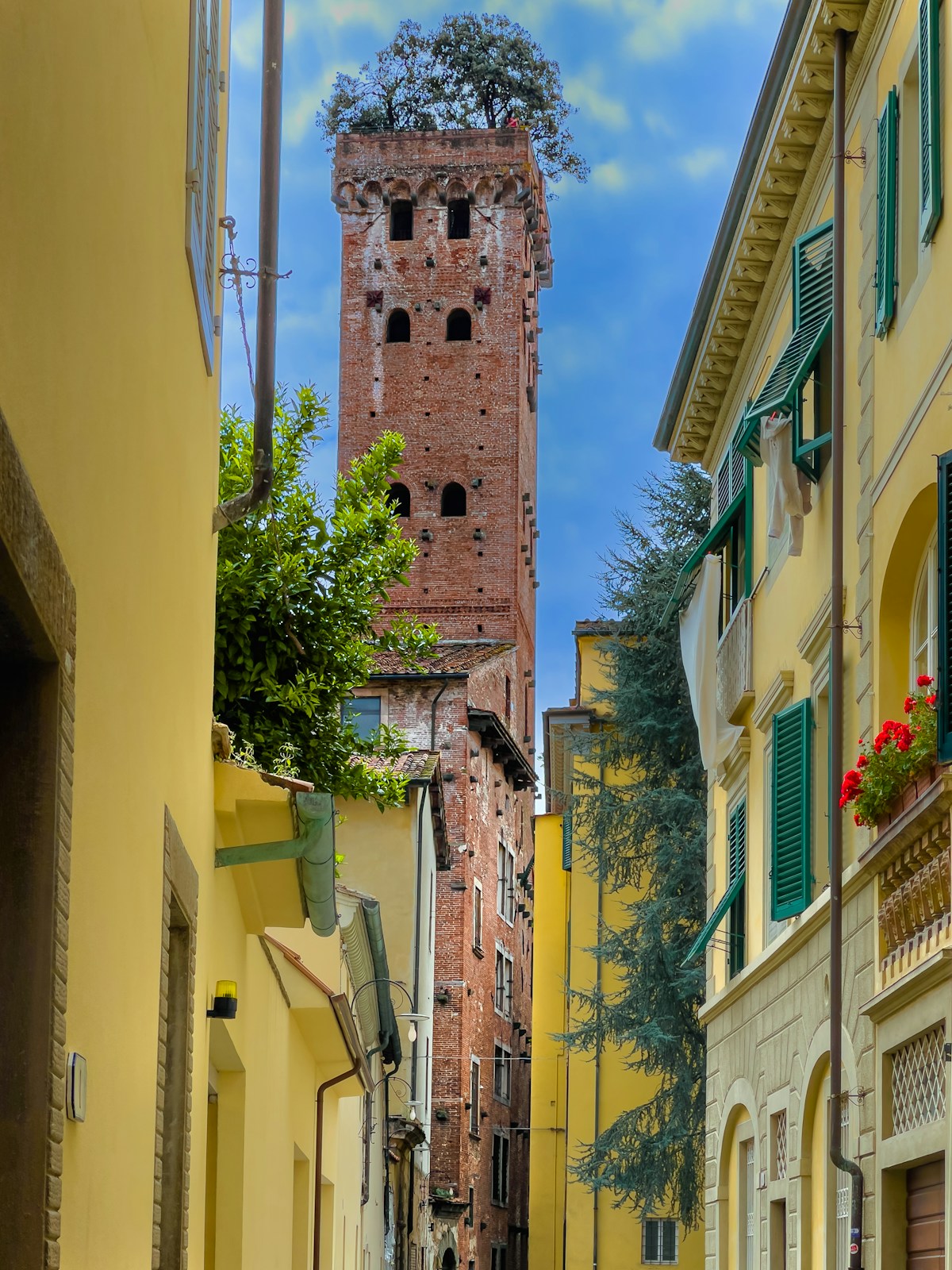
The medieval tower of the Guinigi family, with oak trees growing from the roof. The image of trees on top of a tower is the most characteristic image of Lucca. 45m high; 227 steps; views over the city and, on clear days, to the Apuan Alps. €5 entry.
Puccini Museum and the opera connection
Giacomo Puccini (1858–1924) was born in Lucca. The house on Corte San Lorenzo is now a museum with manuscripts, photographs, and the piano on which he composed. The Puccini Festival (July–August, held at Torre del Lago, 20km west, on the lake where Puccini lived) is one of the major open-air opera events in Italy - La Bohème, Tosca, Madama Butterfly, and Turandot are performed in rotation.
Day trips from Lucca
Pisa (30 minutes by train) - the Leaning Tower and the Piazza dei Miracoli. A natural half-day excursion.
Cinque Terre (1.5 hours by train via La Spezia) - the five clifftop villages on the Ligurian coast. Possible day trip.
Garfagnana and the Apuan Alps (30–45 minutes by car) - the mountain valley north of Lucca. The Parco delle Alpi Apuane has spectacular walking and the marble quarries of Carrara (the same marble used by Michelangelo) are visible in the white-scarred peaks.
Collodi (20 minutes) - the village where Carlo Lorenzini (who wrote Pinocchio under the pen name Carlo Collodi) spent his childhood. The Pinocchio Park and the Villa Garzoni gardens.
Book Lucca Tours on GetYourGuide
| Tour | Duration | From price | Highlights |
|---|---|---|---|
| Lucca walking tour — walls, Duomo, and Piazza dell’Anfiteatro | 2 hrs | From €20 | Renaissance walls, Romanesque churches, Roman amphitheatre oval |
| Lucca e-bike wall circuit and wine tasting | 3 hrs | From €45 | 4km wall cycle, Tuscan wine tasting, Torre Guinigi |
| Lucca and Pisa day trip from Florence | 9 hrs | From €60 | Two Tuscan cities, Leaning Tower, small group with guide |
Browse all Lucca tours on GetYourGuide →
Back to the full Lucca travel guide for the city walls, tower walks, and practical information. For Lucca food - farro soups, local olive oil, and the Garfagnana products - see the Lucca food guide. For day trips from Lucca to Florence, Pisa, and the Cinque Terre, see day trips from Lucca. For accommodation in Lucca, see best hotels in Lucca. Lucca is a key stop on any Tuscany circuit - our Tuscany itinerary maps the connections. For a Pisa comparison, see our Pisa guide.
Where to stay in Lucca: Find hotels in Lucca — search accommodation across all budgets.