Lucca Travel Guide: Tuscany's Walled City
Your guide to Lucca: the intact Renaissance walls, Romanesque churches, Puccini's birthplace, and cycling along the top of the old walls.
Guides for Lucca
Lucca is the most pleasant small city in Tuscany for unhurried visitors. Unlike Siena or San Gimignano, it doesn’t receive the same coach-tour volumes, and the experience of walking its streets is markedly quieter. The city is defined by two things: its intact Renaissance walls (4km circuit, wide enough to walk or cycle on top) and its collection of Romanesque churches, several of which are among the finest in Italy.
The walls
The Renaissance fortification walls (le Mura) were built between 1504 and 1645 and never demolished. They survived because they were never needed for their intended purpose - Lucca was never besieged after they were completed. Today the top of the walls is a 4km tree-lined public promenade, wide enough for cycling, with views over the city rooftops and the Apuan Alps to the north. Walking the full circuit takes approximately 45 minutes; cycling approximately 20 minutes. Bicycle rental is available at multiple points around the walls (approximately €5/hour, approximately €15/day).
The churches
San Michele in Foro - Romanesque church built on the site of the Roman forum. Its facade - five tiers of blind arcading with twisted columns, each column different - is the most elaborate in Lucca. The massive bronze statue of the Archangel Michael tops the building. Free entry; open daily 7:40am–12pm and 3pm–6pm.
Cattedrale di San Martino - The cathedral contains the Volto Santo (Holy Face), a Byzantine crucifix venerated since the 11th century - pilgrims have been coming to Lucca to see it for over 900 years. The marble tomb of Ilaria del Carretto by Jacopo della Quercia (1406) is one of the finest funerary monuments of the early Renaissance - a young woman portrayed asleep, with a small dog at her feet. Cathedral free entry; Ilaria tomb and sacristy approximately €3 as of 2026.
San Frediano - A large basilica with a 13th-century gold mosaic on the facade (the Ascension) and a Romanesque baptismal font inside. Free entry.
Piazza dell’Anfiteatro
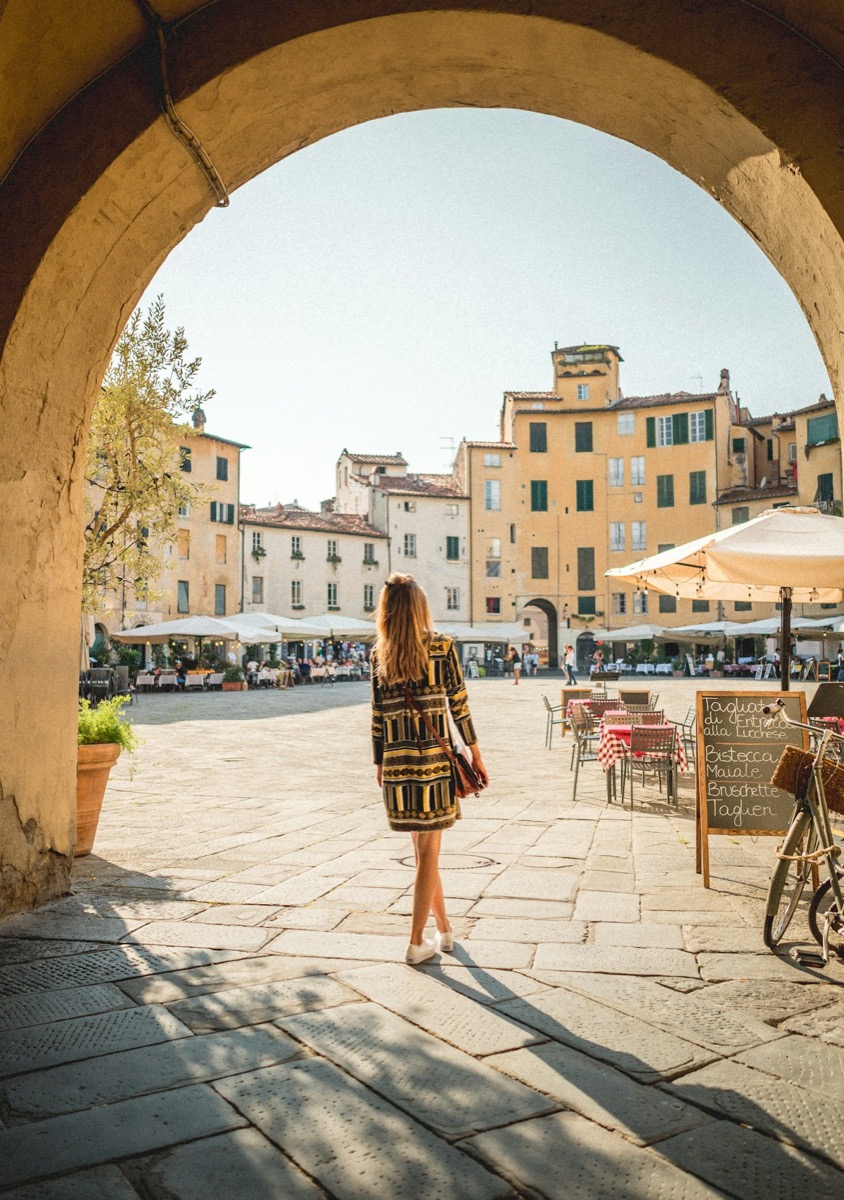
An oval piazza built over the footprint of the Roman amphitheatre (2nd century AD), whose curved form the surrounding medieval buildings retain exactly. Houses and shops now occupy what were once the amphitheatre’s arched openings. The piazza is accessed through four archways; the enclosed space is one of the most distinctive urban forms in Italy. Cafes and restaurants line the interior.
Other sights
Torre Guinigi - A medieval tower with a garden of holm oak trees growing on the roof - one of Lucca’s most distinctive landmarks. Climb 230 steps for views over the city. Entry approximately €5. Open daily.
Torre delle Ore (Clock Tower) - The tallest tower in Lucca at 50m. 207 steps. Entry approximately €5. Open daily.
Casa Natale di Giacomo Puccini (Corte San Lorenzo 9) - The birthplace of the opera composer (1858–1924), now a small museum with scores, costumes, and the Steinway piano on which he composed Turandot. Entry approximately €9 as of 2026. Open daily.
Palazzo Pfanner (Via degli Asili 33) - An 18th-century palazzo with an Italianate garden visible from the walls. Entry approximately €6.50 for house and garden.
Where to eat
Lucchese cuisine is Tuscan but has local specialities: tordelli (large stuffed pasta with meat ragù), zuppa di farro (spelt soup), and buccellato (a ring-shaped sweet bread with raisins and anise, sold at the Taddeucci bakery on Piazza San Michele since 1881). Trattoria da Leo (Via Tegrimi 1 - mains approximately €8–12, cash only) is a local institution for Tuscan home cooking. Osteria San Giorgio (Via San Giorgio 36 - mains approximately €12–16) serves refined Lucchese dishes.
Where to stay
Budget: approximately €50–70/night. Mid-range: approximately €80–130/night. Hotel Ilaria (Via del Fosso 26 - doubles from approximately €90/night) is well-positioned inside the walls. Several B&Bs operate in converted palazzi within the old city, offering good value.
Getting there
Lucca station: regional trains from Pisa approximately 30 minutes (approximately €4), from Florence approximately 90 minutes (approximately €8, change at Pisa or direct via Pistoia). The station is a 5-minute walk from the walls. Lucca is an excellent half-day or full-day trip from Florence or Pisa.
Practical details
Bicycle rental: Cycling the walls is one of the defining Lucca experiences. Rentals are available at several shops just outside the main gate near the station - Cicli Bizzarri (Piazza Santa Maria 32, approximately €3/hour or €15/day) and similar shops near Porta San Pietro. The wall path is wide enough for relaxed cycling; the full circuit takes approximately 20 minutes by bike. The path is shared with pedestrians - go slowly.
What to allow time for: Half a day covers the walls, the three main churches (San Michele, San Martino, San Frediano), and the Piazza dell’Anfiteatro. A full day adds Torre Guinigi, Casa Puccini, and a proper lunch. The Lucca Comics and Games festival (late October/early November) draws an enormous crowd - book accommodation well ahead if visiting then.
Puccini connection: Lucca takes its most famous son seriously. Beyond the Casa Natale, the Centro Studi Giacomo Puccini hosts summer concerts, and the Teatro del Giglio (Piazza del Giglio) performs Puccini operas regularly from spring to autumn. Check teatrodelgiglio.it for the programme (tickets approximately €15–45). The annual Puccini e la sua Lucca concerts are held inside the church of San Giovanni.
For accommodation inside the walls: Lucca hotels. For the Guinigi tower, bicycle wall circuit, and Puccini museums: things to do in Lucca. Book a guided tour of Lucca to explore the Romanesque churches, the walls circuit, and the Puccini connection with a local guide. For local Tuscan food - tordelli, buccellato, and the best restaurants: Lucca food guide and the Tuscan food guide. Lucca pairs naturally with Pisa (30 minutes by train) in a day trip from Florence.
Accommodation options: The walls contain the entire old city and most accommodation is within them. Piccolo Hotel Puccini (Via di Poggio 9 - doubles from approximately €70/night) is affordable and well-positioned near San Michele. Hotel Ilaria (Via del Fosso 26 - doubles from approximately €90/night) is a converted 15th-century building near the Porta Elisa, with a small garden. For a higher-end option, Palazzo Dipinto (Via degli Angeli - doubles from approximately €140/night) is a boutique palazzo near Piazza dell’Anfiteatro. Agriturismo options outside the walls cost approximately €60–90/night and are practical if arriving by car.
For the full accommodation breakdown: Lucca hotels guide. For sights, museums, and the walls circuit in detail: things to do in Lucca. For the regional food - pici pasta, olive oil, and Lucchese meat dishes: Lucca food guide and Tuscan food guide. Planning a Tuscany trip? Lucca is covered as a stop in our Tuscany itinerary and 1-week Italy itinerary.
Upcoming Events in Lucca
La Befana - Feast of the Epiphany 2027
La Befana 2027, January 6. Italy's Epiphany gift-giving day: children receive sweets or coal from the Befana witch, then decorations come down.
Book an experience
Top experiences in Lucca
Explore the best tours and activities in Lucca, with instant confirmation and free cancellation on most bookings.