Capri is one of the most visited islands in the Mediterranean, and for good reason: the scenery is dramatic, the water is impossibly clear, and the light has a quality that painters have tried to capture for centuries. It is also one of the most crowded, particularly in summer. Getting the most from a visit to Capri means understanding how the island works - when the day-trippers arrive, where to go before and after, and which attractions genuinely justify the effort.
The Blue Grotto (Grotta Azzurra)
The most famous attraction on Capri is a sea cave on the northwest coast where sunlight filters through a submerged opening and illuminates the water with an intense azure glow. The effect is real and spectacular - unlike some famous sights, the Blue Grotto does live up to expectations.
Getting there involves a motorboat from Marina Grande (approximately €18 per person for the motorboat plus approximately €14–16 for the rowing boat entry as of 2026, total approximately €32–34), then a transfer into a tiny wooden rowing boat, lying flat as the rower pulls you through the low entrance by a chain on the cave wall. Once inside, the cave opens up to perhaps 12 metres wide, and the water glows with cold blue light from the submerged opening below.
The grotto is closed when sea conditions are rough, which happens frequently - particularly in autumn and winter, and unpredictably throughout the year. Check conditions before booking. The queue can be long in peak season: aim to arrive before 10am.
Top Tours at a Glance
| Tour | Duration | Price (from) | Group Size | Highlights |
|---|---|---|---|---|
| Capri boat tour — Faraglioni and Blue Grotto | 4 hrs | from €55 | Up to 12 | Sea arch passage, grotto, swimming coves |
| Capri island tour — Monte Solaro + Anacapri | 5 hrs | from €65 | Up to 15 | Chairlift, Villa San Michele, panoramic views |
| Private boat hire around Capri | 4 hrs | from €150 | Private | Flexible itinerary, swimming stops, sea caves |
| Day trip to Capri from Naples | Full day | from €80 | Up to 20 | Ferry included, guided island tour, free time |
Browse all Capri tours → GetYourGuide
The Faraglioni Rocks
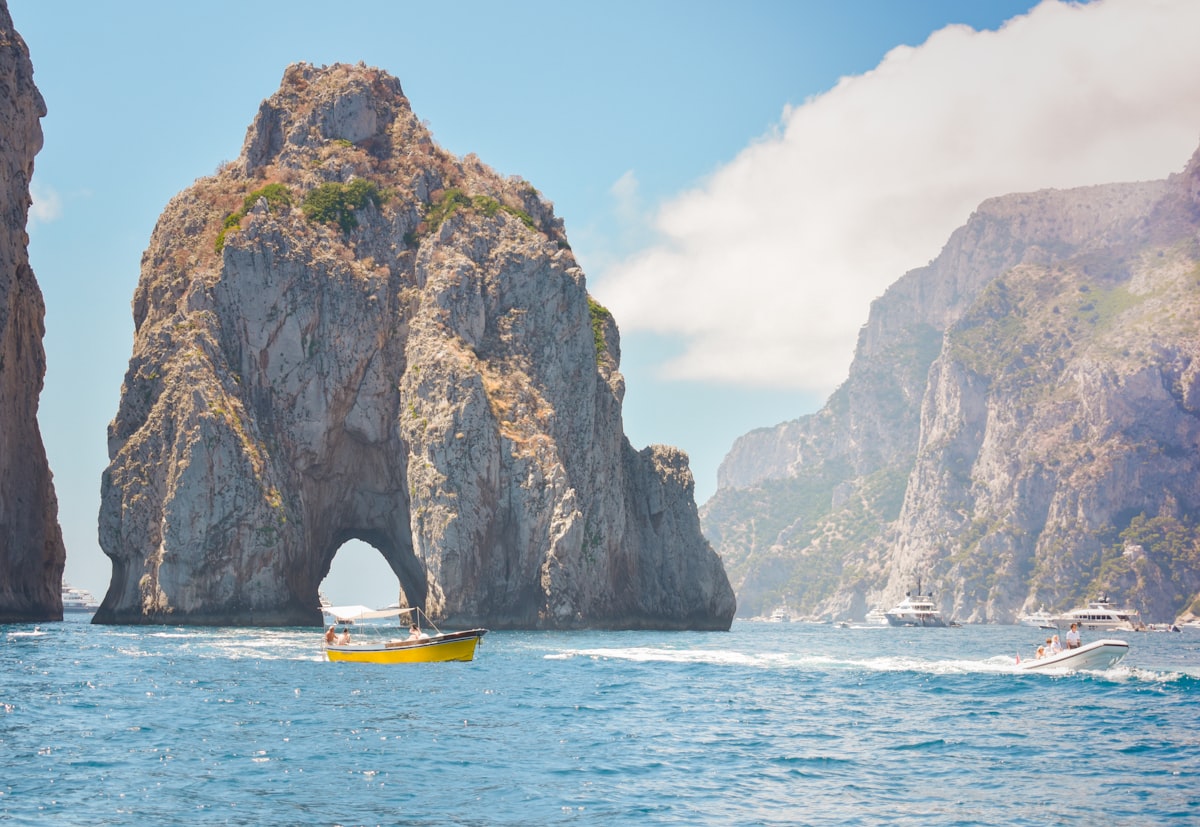
Three limestone sea stacks rise from the water on Capri’s southeastern shore - the Faraglioni are the island’s most photographed sight and visible from much of the south coast. The middle stack (Faraglione di Mezzo) has a natural arch that small boats can pass through, and boat tours from Marina Grande run circuits past all three.
Viewing them from land is straightforward: walk from Capri town down to the Punta Tragara belvedere (approximately 25 minutes on foot along Via Tragara) for the classic head-on perspective. Sunrise and late afternoon light are best. The walk is on paved roads and is easy, though the return is uphill.
Villa Jovis
The largest of Emperor Tiberius’s twelve villas on Capri, Villa Jovis stands on the island’s northeastern headland at 334 metres above sea level. Tiberius ruled the Roman Empire largely from here between AD 27 and 37 - more than a decade of one of the most powerful men in the world governing from this cliff.
The ruins are substantial: you can trace the outline of the water cisterns, the baths, the audience hall, and the imperial apartments. The setting is extraordinary - views across the Bay of Naples to Sorrento, Ischia, and on clear days to Vesuvius. Entry costs approximately €6 as of 2026. The walk from Capri town takes approximately 40–50 minutes uphill; the path is signposted from Via Sopramonte. Allow 1.5–2 hours total.
Anacapri and the Monte Solaro Chairlift
Anacapri is the island’s second town, quieter and more residential than Capri town, situated on the higher western plateau. From Anacapri’s central square, a single-seat chairlift (seggiovia) climbs to Monte Solaro, Capri’s highest point at 589 metres, in approximately 12 minutes. The views from the top - across the entire island, the Bay of Naples, the Amalfi Coast in the distance, and the Faraglioni far below - are among the best in southern Italy.
The chairlift costs approximately €13 one-way or €16 return as of 2026. Go on a clear morning before any coastal haze develops. The summit has a small bar, stone terraces, and a 12th-century chapel. You can walk down via a signed trail to Anacapri in approximately 45 minutes if you prefer to skip the return ride.
In Anacapri, the Villa San Michele (formerly owned by Swedish physician Axel Munthe) is worth the €10 entry fee as of 2026: the garden terraces, Egyptian sphinx, and bay views are exceptional. The Baroque church of San Michele contains an elaborate 18th-century majolica floor depicting the Garden of Eden - enter from the side door.
The Natural Arch (Arco Naturale)
A short walk from Capri town (approximately 20 minutes from Piazza Umberto I via Via Matermania) leads to a large natural limestone arch formed by coastal erosion. The path passes the Grotta di Matermania, a Roman nymphaeum cut into the cliff. The arch itself frames a dramatic view of the sea below. The walk is moderate - some uneven steps - and takes approximately 1.5 hours return including both the arch and the grotto.
Marina Piccola and Swimming
Capri’s best swimming beach, Marina Piccola, lies on the south coast below Capri town. The beach is a combination of private lido (sunbeds approximately €15–25/day as of 2026) and a small public section. The water is exceptionally clear. In summer, get there before 10am - the beach fills quickly and access by bus from Capri town (approximately €2, approximately 5 minutes) is straightforward.
For quieter swimming, the rocky platforms and ladders at Punta Masullo and along the cliffs east of Marina Piccola offer more space and equally clear water. Several of Capri’s hotels with sea access allow outside guests to use their platforms for a fee.
Getting Around the Island
Capri restricts private cars severely. Visitors typically arrive at Marina Grande by ferry or hydrofoil, then take the funicular up to Capri town (approximately €2.20 as of 2026, approximately 4 minutes), or a taxi (approximately €8–12). The local bus network connects Capri town, Anacapri, Marina Piccola, and the western coast - single tickets approximately €2, day passes approximately €7.20 as of 2026.
The island is small enough that the main sights (Faraglioni viewpoint, Arco Naturale, Villa Jovis) are walkable from Capri town, but the terrain is steep in places - wear comfortable shoes and carry water in summer.
Where to stay in Capri: Find hotels in Capri — search accommodation across all budgets.