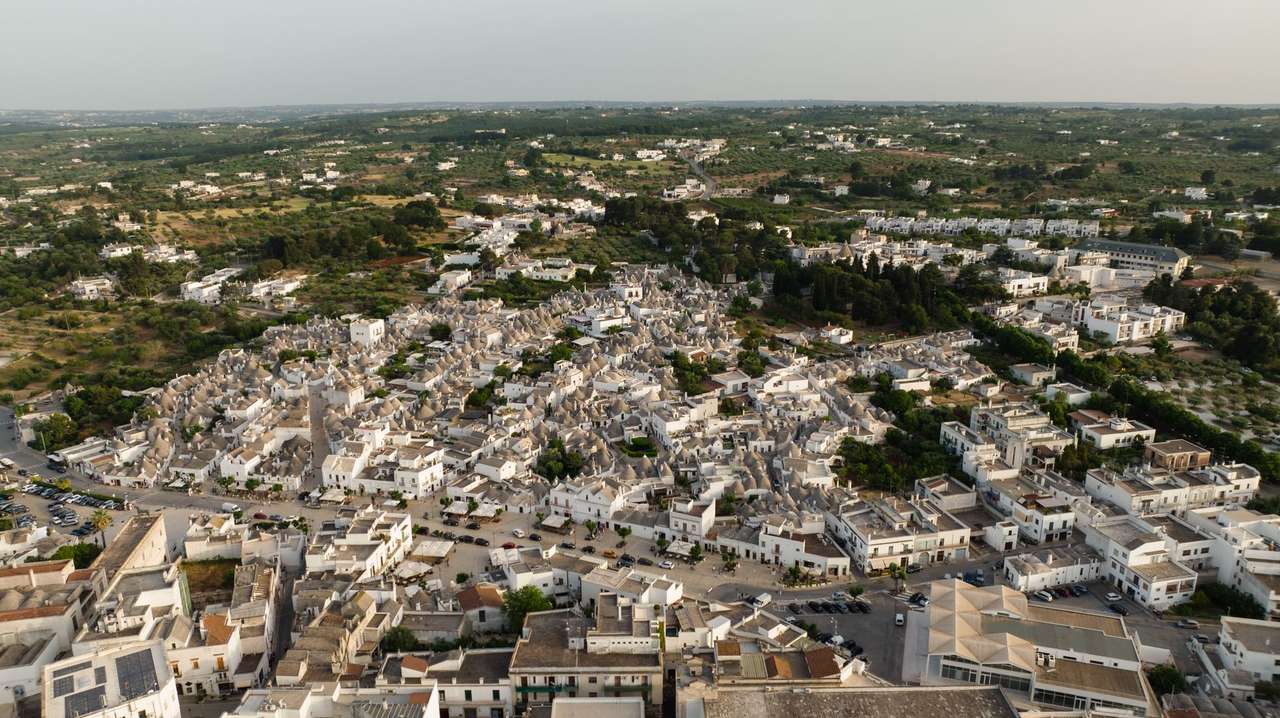
Puglia — the heel of Italy’s boot — is the country’s most underrated region for first-time visitors and the one that produces the most instant converts. The architecture is unlike anywhere else in Italy: whitewashed Baroque towns rising from red-earth fields, limestone cliff villages above an improbably blue Adriatic, and the trulli of Alberobello — conical stone houses that look like something from an illustrated fairy tale and are in fact the product of a very practical medieval tax-avoidance scheme.
The region stretches almost 400 km from the Gargano promontory in the north to Santa Maria di Leuca at the tip of the heel, a distance that rewards slow travel. The main clusters for visitors are the northern coast around Vieste, the central zone around Bari and the Valle d’Itria (Alberobello, Locorotondo, Ostuni), and the Salento peninsula in the south anchored by Lecce and the Adriatic and Ionian coastlines.
Bari
Bari is the regional capital and main transport hub — where most visitors arrive by train or plane. The new city is a 19th-century grid of wide boulevards; the interest is in the Bari Vecchia (old city), a dense medieval labyrinth of narrow alleys on a promontory into the Adriatic.
The Basilica di San Nicola (Piazza San Nicola) in the old city is the pilgrimage destination that puts Bari on the map — the 11th-century church contains the remains of Saint Nicholas, patron of children and the historical figure behind the Santa Claus myth. Entry is free; the crypt is open Monday to Saturday 07:30–13:00 and 15:00–19:00, Sunday 07:30–13:00. The Castello Normanno-Svevo (Piazza Federico II di Svevia), a Norman-era fortress with a Hohenstaufen core, costs approximately EUR 4 to enter.
In the old town’s alleys, look for women making orecchiette pasta by hand at their doorsteps — this is not a performance for tourists but a genuine local practice that has survived largely intact.
Where to stay in Bari:
- Niccolò Hotel — Stylish boutique hotel in the new city, near the central station. Rooms from approximately EUR 130–200 per night.
- Hotel Oriente — A solid mid-range option close to Piazza Umberto I. From approximately EUR 90–140 per night.
- M&L Hostel Bari — Clean budget option in the new city, a short walk from the old quarter. Dorm beds from approximately EUR 22; private rooms from approximately EUR 65.
Where to eat in Bari:
- Trattoria Piccola Cucina (Via Nicolai) — Reliable old-city trattoria, strong on orecchiette alle cime di rapa (orecchiette with turnip tops) and local grilled fish. Approximately EUR 20–35 per person.
- Panificio Fiore (Via Calefati) — The best place to try focaccia barese, the flat spongy bread topped with tomato and olives that is Bari’s street food staple. A large slice costs approximately EUR 2–3.
Lecce
Lecce is called the “Florence of the South” by people who want to sell it, and the comparison is not completely idle — the historic centre contains a concentration of Baroque architecture built in a local golden limestone that is unusually workable, which led 17th-century architects and patrons to go somewhat overboard with the ornamentation. The effect is remarkable: there is nothing quite like Lecce’s facade programme elsewhere in Italy.
The Basilica di Santa Croce (Via Umberto I) is the set piece — a facade of extraordinary sculptural density, with caryatids, grotesques, and garlands cascading across three horizontal bands. Entry is free. The Piazza del Duomo nearby is a theatrical enclosed space with the cathedral, the bishop’s palace, and a campanile all facing inward, closed off from the rest of the city by a single entrance — atmospheric at any time of day and remarkable in the late afternoon light.
Where to stay in Lecce:
- Patria Palace Hotel — The city’s most storied hotel, directly opposite Santa Croce, in operation since 1883. Rooms from approximately EUR 180–280 per night.
- Hotel Risorgimento Resort — A five-star option inside a 19th-century palazzo near Piazza Sant’Oronzo. From approximately EUR 220–350 per night.
- Viale Azzurro B&B — Well-reviewed budget option in the historic centre. From approximately EUR 70–100 per night.
Where to eat in Lecce:
- Trattoria le Zie (Via Costadura 19) — Family-run, cash-preferred, the kind of place Lecce residents actually eat. Orecchiette, fava bean puree, horse-meat ragu. Approximately EUR 18–28 per person.
- Alle due Corti (Corte dei Giugni 1) — More polished than le Zie, with a good regional wine list and dishes that incorporate lesser-known Salentine ingredients. Approximately EUR 30–45 per person.
Alberobello
Alberobello is a small town about 55 km south-east of Bari whose upper districts are composed almost entirely of trulli — whitewashed stone houses with conical roofs that were built without mortar so they could be quickly dismantled when tax inspectors arrived in the medieval period. The conical grey rooftops are covered with carved symbols whose meanings are disputed. In 1996 the town became a UNESCO World Heritage Site.
The main trulli district, Rione Monti, is pedestrianised and freely accessible at all times. The Trullo Sovrano (Piazza Sacramento 4) is the only two-storey trullo open to visitors as a museum; entry costs approximately EUR 3 as of 2026, open daily 10:00–18:00 (reduced hours in winter).
Alberobello is extremely busy in July and August — a morning visit before 10:00 gives you the streets largely to yourself. Some trulli have been converted to holiday apartments, which makes staying in one a genuine option (prices range from approximately EUR 80–200 per night depending on season and size).
Getting there from Bari: Ferrovie del Sud-Est (FSE) trains run from Bari Centrale to Alberobello (approximately 1.5 hours, fare approximately EUR 4–5). A hire car from Bari allows you to combine Alberobello with Locorotondo and Ostuni in a single day.
Polignano a Mare
Polignano a Mare sits on a limestone promontory above the Adriatic, its white houses overhanging the cliff edge and the water below visible through sea caves at the base. The town is tiny — the historic centre takes 20 minutes to walk around — but it has a concentrated drama that justifies the detour, particularly in the golden hour before sunset.
The Lama Monachile sea cave below the main bridge is the most photographed spot; access via steps from the town is free. The cliff-jumping contest held here each September (the Red Bull Cliff Diving World Series) is internationally followed.
The nearest train station is Polignano a Mare on the Bari–Lecce Adriatica line (approximately 30 minutes from Bari, fares from approximately EUR 3–4).
Ostuni
Ostuni, the white city, occupies a hill above the olive-grove flatlands of the Itria valley and can be seen from the Adriatic for miles. The historic centre is genuinely white — buildings are limewashed annually by local ordinance — and the cathedral at the top of the hill has an unusual rose window combining Gothic and Byzantine elements.
The town is a pleasant half-day on foot. For overnight stays, it works well as a base for the Valle d’Itria: within 30 minutes you can reach Alberobello, Locorotondo, Cisternino, and Fasano by car.
Where to stay:
- Masseria Il Frantoio — An organic farm estate outside Ostuni, one of the more atmospheric agriturismos in the region, with cooking classes using their own olive oil and wine. Rooms from approximately EUR 180–300 per night.
- Latitudini B&B — Comfortable mid-range option inside the white city walls. From approximately EUR 90–130 per night.
Food and Drink
Puglia’s food culture is straightforwardly excellent. The staples are:
- Orecchiette alle cime di rapa — the region’s signature pasta dish, made with small ear-shaped pasta and bitter turnip tops dressed in anchovy-infused olive oil and garlic. Found everywhere; made properly, it is one of the better things you will eat in Italy.
- Burrata — fresh mozzarella with a cream filling, originally from Andria in northern Puglia. Eaten at room temperature with good bread. Approximately EUR 2–4 for a single serving at a latteria (dairy shop).
- Taralli — hard small bread rings baked with olive oil and fennel seeds, sold in bags at every alimentari. The natural Puglian alternative to a mid-morning pastry.
- Negroamaro and Primitivo — the two dominant red grape varieties of southern Puglia, both capable of producing wines of real concentration. Primitivo di Manduria is the most internationally recognised appellation.
- Pugliese olive oil — the region produces approximately 40% of Italy’s total olive oil output. Extra-virgin oil from Coratina olives (northern Puglia) and Ogliarola Salentina (south) is robustly flavoured and available for purchase at farms and markets throughout the region.
Getting to Puglia
By train from Rome: Trenitalia Intercity services connect Roma Termini to Bari Centrale in approximately 3.5 to 4 hours (fares from approximately EUR 30–60 depending on class and booking window). High-speed services do not extend to Puglia as of 2026; book at trenitalia.com.
By air: Ryanair, Volotea, and easyJet operate routes into Bari Palese Airport (BRI) and Brindisi Airport (BDS) from multiple European cities. Bari airport is approximately 10 km from the city centre; shuttle buses run to Bari Centrale station.
By car: The A14 Adriatica motorway connects Bologna to Bari via the Adriatic coast — the fastest overland route from northern Italy. Rome to Bari by car is approximately 4.5 hours via the A1 and A16.
Getting Around Puglia
The main cities (Bari, Lecce, Brindisi, Taranto) are connected by Trenitalia’s Adriatica line with services roughly every 30 to 60 minutes. FSE (Ferrovie del Sud-Est) trains serve the Valle d’Itria from Bari (Alberobello, Locorotondo, Martina Franca, Taranto) at lower frequency.
A rental car gives you considerably more flexibility for coastal towns and the inland masserie. Hire from Bari Airport and return at Brindisi Airport (or vice versa) is a logical one-way route for a touring trip down the heel. See our renting a car in Italy guide for what to expect on costs and the rules on ZTL zones in old city centres.
Best Season
June to September is Puglia’s main season, with long days, warm Adriatic water, and the full range of restaurants and accommodation open. The coast becomes busy with Italian domestic tourists in August — accommodation in Polignano, Ostuni, and Gallipoli fills quickly and prices are at their peak.
Late June and early September are the best weeks in terms of weather versus crowd balance.
Spring (April to May) is excellent for cycling and walking the interior, wildflowers in the olive groves, and visiting the archaeological sites without summer heat.
Winter is mild (10–15°C in most years), very quiet, and dramatically cheaper — a good time to visit Lecce and Bari if you are not prioritising beach time.