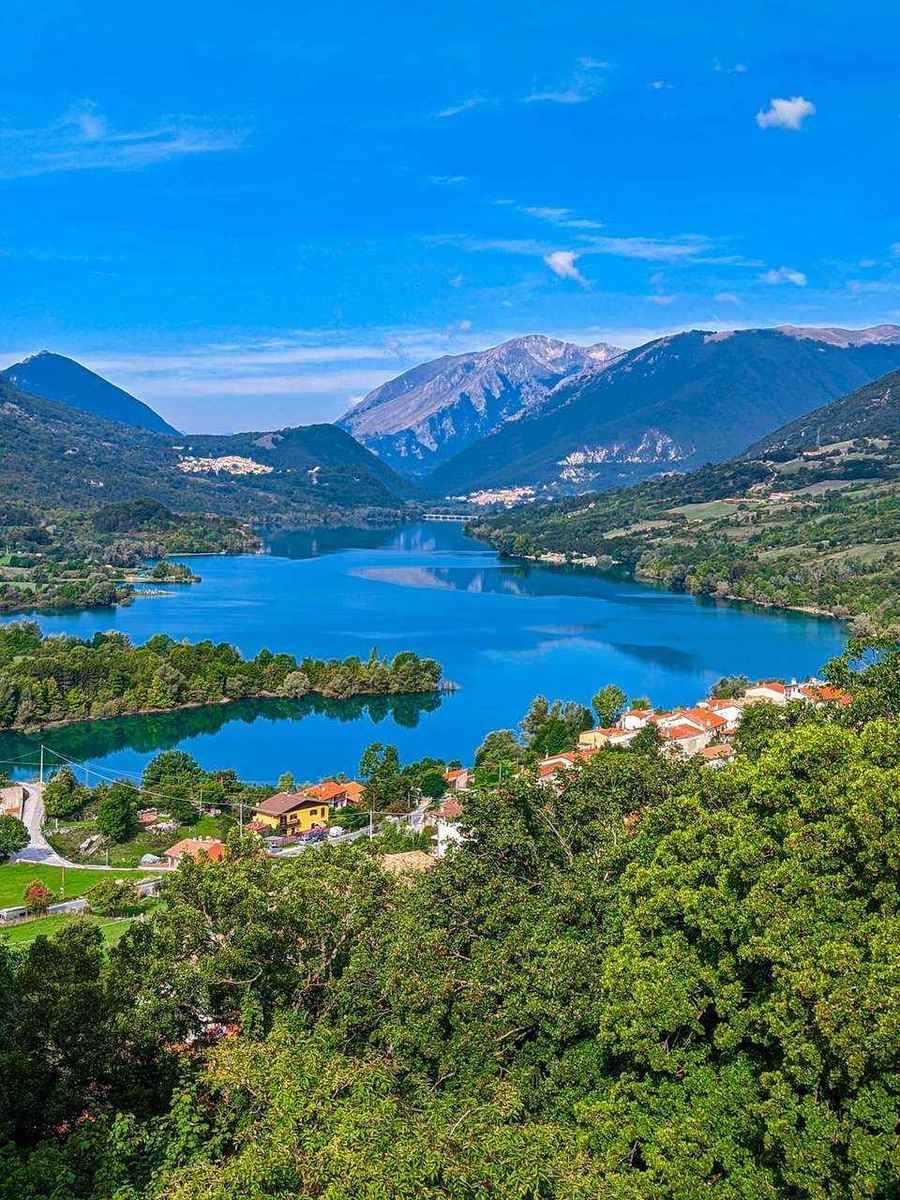
Abruzzo occupies the central Apennines east of Rome — a region of high mountains, deep river gorges, and a short Adriatic coastline that remains significantly less visited than the beaches further south. It borders Lazio to the west, Umbria and Le Marche to the north, Molise to the south-east, and the Adriatic to the east, and it contains more protected natural area per square kilometre than almost anywhere else in the Italian peninsula. Three national parks and dozens of regional nature reserves cover roughly a third of the region’s total area, making it one of the most important wildlife refuges in Europe.
This is not a region that announces itself with famous landmarks or internationally recognisable names. The appeal is different from Rome or Florence — slower, less mediated, and more dependent on moving through the landscape rather than collecting it. Guided tours and hiking excursions in Abruzzo are available for the national parks and Gran Sasso, and make a practical starting point if you want expert local knowledge of trail access and wildlife.
L’Aquila
The regional capital sits at 714 metres altitude in a wide valley between the Gran Sasso massif and the Velino mountains. The city suffered catastrophic earthquake damage in April 2009 — nearly 310 people were killed and large parts of the historic centre were destroyed. Reconstruction has been ongoing since, and a visit today shows a city that is genuinely rebuilt in parts and still actively rebuilding in others. It is an unusual and sobering place to visit, and worth understanding clearly before arriving.
The Basilica di Santa Maria di Collemaggio (Piazza di Collemaggio) is the city’s most important monument — a 13th-century church with a distinctive pink and white stone facade in Romanesque-Gothic style. It is the church associated with the Perdonanza Celestiniana, a papal indulgence granted in 1294 that predates the Jubilee. Entry is free; open daily approximately 07:30–12:00 and 15:30–19:30 (verify current hours locally as restoration work affects schedules).
The National Museum of Abruzzo (Castello Cinquecentesco, Viale Crispi) reopened progressively after the earthquake and holds pre-Roman, medieval, and modern art including a mammoth skeleton found locally in 1954. Entry costs approximately €4 as of 2026; open Tuesday to Sunday 09:00–19:00.
Where to stay in L’Aquila:
- Grand Hotel e del Parco — The city’s most established four-star hotel, in a solid early 20th-century building. Rooms from approximately €90–150 per night.
- Hotel Duca degli Abruzzi — Central mid-range option with comfortable rooms and reliable service. Rooms from approximately €70–110 per night.
Where to eat in L’Aquila:
- Osteria Antiche Mura (Via Fortebraccio 1) — Traditional Abruzzese cooking: lamb with rosemary, saffron pasta, roast kid in season. Budget approximately €25–40 per person.
- Ristorante Le Tre Marie (Via Tre Marie 3) — One of the city’s longer-established restaurants, with a focus on locally sourced mountain ingredients. Approximately €30–45 per person.
Sulmona and the Peligna Valley
Sulmona is the most visited town in inland Abruzzo and the most convenient base for combining the region’s main attractions. The birthplace of the Latin poet Ovid (43 BC), it sits in the Peligna valley at the junction of three rivers, surrounded by mountains on three sides. It is compact, walkable, and animated by the confetti trade — sugar-coated almonds that the town has produced and exported for over 500 years.
Read our full guide to things to do in Sulmona for attraction entry fees, hotels, and restaurants in detail.
Scanno
Scanno is a mountain village at 1,050 metres in the upper Sagittario gorge, 30 kilometres south of Sulmona by road. The village is known for its medieval architecture, distinctive local dress still worn by older women on feast days, and above all for Lake Scanno below — a glacial lake whose shape from the surrounding hills traces a heart, making it one of the most photographed natural features in the region.
Read our full guide to Scanno and Lake Scanno for the village, hiking routes, and practical information.
Abruzzo, Lazio and Molise National Park
The oldest national park in Italy (established 1923), the Parco Nazionale d’Abruzzo, Lazio e Molise covers 500 square kilometres of high Apennine terrain in the southern part of the region. The main gateway town is Pescasseroli, reached by bus from Avezzano (approximately 1.5 hours, fares from approximately €5 as of 2026) or by car along the SS83.
The park is home to the Marsican brown bear — a subspecies found only in this area, with a population of approximately 50–60 individuals. It is also the last remaining habitat of the Apennine wolf in the central Apennines, and the park re-introduced the Abruzzo chamois (a mountain goat subspecies) after near-extinction in the 20th century. Bear sightings are more common in the early morning or at dusk near the town of Barrea, particularly in early summer.
The Visitor Centre in Pescasseroli (Via Colli dell’Oro) has maps and trail information; entry to the wildlife museum costs approximately €3 as of 2026, open daily 10:00–13:00 and 15:00–18:00 (hours vary seasonally). Guided wildlife-watching tours operate from Pescasseroli and Barrea — book in advance for the spring and early autumn shoulder seasons when sightings are most frequent.
Lake Barrea, just below the village of Barrea at the southern end of the park, is the most scenic point of the road route through the park and has walking trails along both shores.
Gran Sasso and Majella National Parks
Gran Sasso e Monti della Laga National Park covers the northern half of the region and takes its name from the Gran Sasso d’Italia massif — the highest point in the Apennines south of the Alps at 2,912 metres (the Corno Grande peak). The park includes the only glacier in the Apennines (the Calderone), high-altitude plateaus, and the medieval city of L’Aquila along its western boundary.
The Campo Imperatore plateau at 1,800 metres is reached by cable car from Assergi (approximately €12 return as of 2026) or by car via a toll road. The plateau is used as a location for film Westerns — its high, treeless grassland resembles the American West more than central Italy. The observatory at the top of the cable car station is open for guided visits in summer (check current schedule at the Osservatorio di Campo Imperatore website).
Majella National Park, south of Sulmona between the Peligna valley and the Aventino river, covers a different landscape: the Majella massif with its broad ridge at 2,793 metres, deeply eroded gorges, and more than 2,000 plant species. The hermitages and cave churches carved into the Majella rock face are the most distinctive cultural feature — the Valle dell’Orfento, accessible on foot from Caramanico Terme, contains several.
The Adriatic Coast
Abruzzo’s Adriatic coast runs for about 130 kilometres from Pescara to the Molise border, with a mix of modern resort towns (Pescara, Francavilla al Mare, Vasto) and quieter sections protected by the Costa dei Trabocchi nature reserve. The trabocchi are wooden fishing machines cantilevered over the sea on long poles — a distinctive coastal feature and now a network of restaurants where fresh fish is cooked and served on the platforms themselves. The Trabocco Turchino near San Vito Chietino is one of the best-known examples; book in advance for dinner in summer.
Pescara is the main transport hub for the region, with a regional airport, an Intercity rail connection to Rome (approximately 3–4 hours, fares from approximately €20–40 as of 2026), and bus connections inland.
Getting to and around Abruzzo
From Rome: Direct buses from Tiburtina bus station to L’Aquila run multiple times daily, taking approximately 1 hour 20 minutes (fares from approximately €10 as of 2026). Buses also serve Avezzano and Pescara from Rome. By car, the A24 motorway from Rome reaches L’Aquila in around 1 hour 20 minutes; the A25 branches south towards Pescara.
Within Abruzzo: Regional trains connect Pescara with Sulmona (approximately 1 hour 20 minutes) and L’Aquila via Avezzano. Buses from Sulmona reach Scanno and Villetta Barrea (for the national park). The mountain areas — the national park interior, Campo Imperatore, Majella trails — are significantly easier with a rental car. Compare car hire rates for Abruzzo before travelling; see our renting a car in Italy guide for tips on booking and costs.
Best time to visit
Spring (April–June): The best season for the national parks — wildflowers on the plateau, bear activity resuming after winter, and comfortable temperatures for walking. The Peligna valley towns are at their most attractive before the summer heat.
Summer (July–August): The Adriatic coast reaches capacity and inland temperatures can be high at low altitudes, though the mountains stay cool. The trabocco restaurants are at their best in summer; book weeks ahead for dinner on the coast.
Autumn (September–October): Excellent for hiking and the national parks, with foliage turning in the beech forests. Saffron harvest in Navelli happens in late October.
Winter (December–March): Skiing at Campo Imperatore and Roccaraso, with a genuine mountain atmosphere in the hill towns. The national park is quieter but wildlife tracking in the snow is one of the most memorable experiences the region offers.