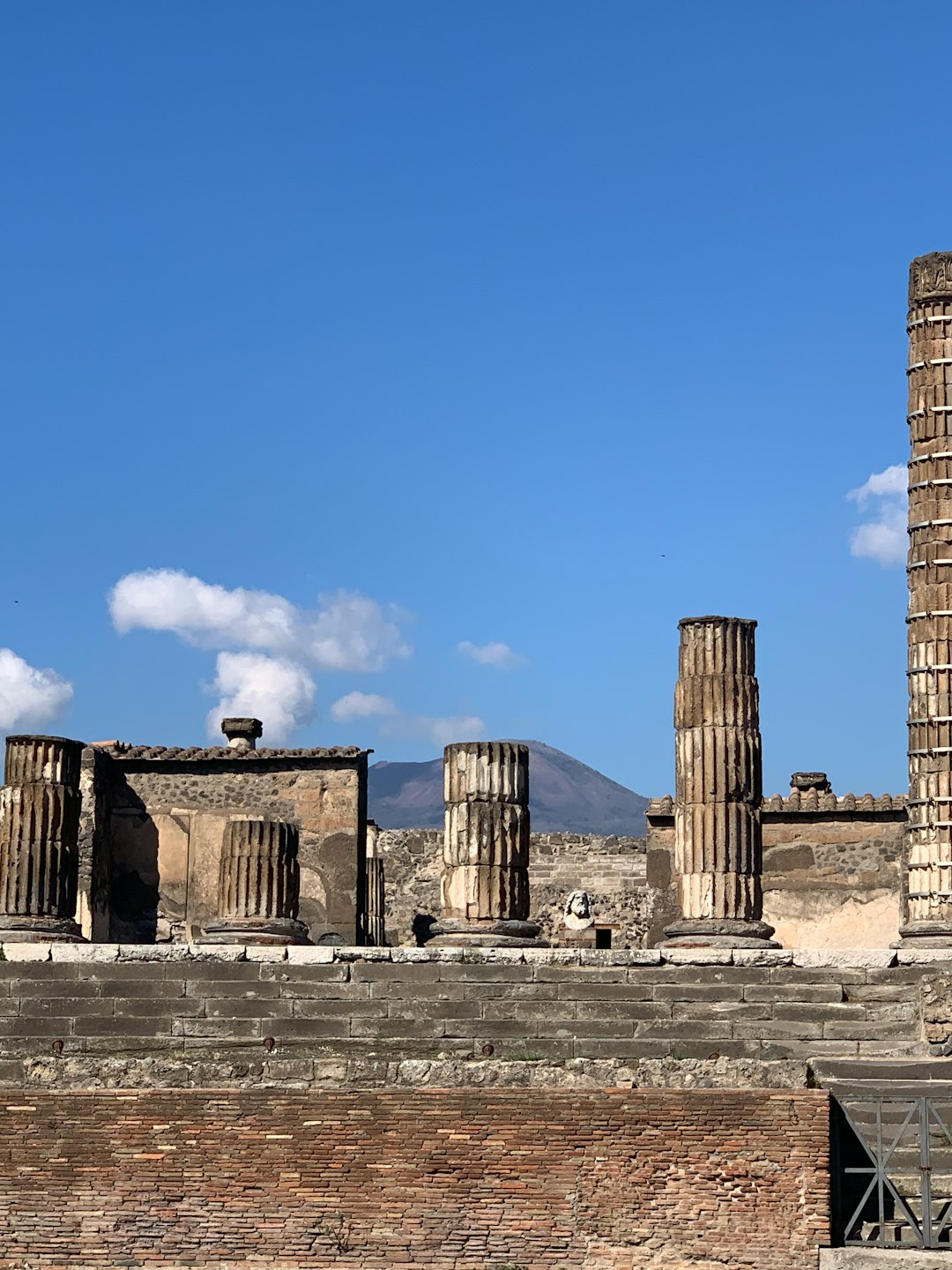
Pompeii is one of the most significant archaeological sites in the world - a Roman city of approximately 11,000 people buried by the eruption of Mount Vesuvius in 79 AD and preserved under 4–6 metres of volcanic ash for nearly 1,700 years. The site covers 44 hectares, with roughly two-thirds excavated since the 18th century. What remains is not a reconstructed ruin but an actual city, with streets, houses, gardens, baths, brothels, bakeries, and temples mostly as they were.
Visiting requires some planning. The site is large, summer crowds are significant, and ticket logistics catch many visitors off-guard.
Entry, Tickets, and Skip-the-Line
Standard entry as of 2026: Approximately €18 per adult. Children under 18 are free for EU residents; EU citizens 18–25 pay a reduced rate of approximately €2. Non-EU visitors under 18 pay the standard adult rate. A combined ticket covering Pompeii, Herculaneum, Oplontis, Torre Annunziata, and Stabiae costs approximately €22 and is valid for 3 consecutive days.
Online booking: Pre-booking a timed entry slot at the Parco Archeologico di Pompei website (pompeiipark.ticketone.it) is strongly recommended from May through September. Walk-up queues in July and August regularly exceed 90 minutes. Pre-booked tickets have a separate fast-track entrance. There is no surcharge for online booking.
Guided tours: A guided tour of Pompeii provides context that transforms the visit - the street layout, the social divisions visible in house sizes, what the painted frescoes mean, where the plaster casts came from. Both half-day tours (2.5–3 hours, the main highlights) and full-day tours (5–6 hours, including outlying houses) are available. Small-group tours typically run €30–50 per person above the entrance fee; private guided tours start at approximately €100–150 for up to 4 people.
Opening hours: Generally 9am–7pm (last entry 5:30pm) in summer, with reduced winter hours. Check the official site before visiting - closures for restoration work affect different sections on a rotating basis.
Best Route Through the Ruins
The site has two main entrances: Porta Marina (the main entrance, closest to the train station) and Piazza Anfiteatro (the eastern entrance, less crowded). Starting from Porta Marina and working east gives a logical progression through the site.
The Forum (Foro): Enter through Porta Marina and you arrive almost immediately at the Forum - the civic heart of Pompeii. The Basilica (the city’s law court, the largest building in Pompeii), the Temple of Jupiter with Vesuvius framed behind it, the Comitium where elections were held, and the city’s administrative offices all border this central space. Spend 30–40 minutes here before moving on.
Via dell’Abbondanza: The main commercial street runs east from the Forum for nearly a kilometre. Shops, taverns (thermopolia - fast food outlets with built-in stone counters), a bakery with the mills and ovens still intact (Forno di Modesto), and painted election notices on the walls. The density of commercial life visible here makes the street the most evocative in Pompeii.
House of the Faun (Casa del Fauno): One of the grandest private houses in the city, taking up an entire city block. The mosaic floor depicting Alexander the Great’s battle against the Persians (the original is in Naples’ National Archaeological Museum; what you see here is a reproduction) gives a sense of the wealth of Pompeii’s merchant class. The dancing faun bronze (also a copy) in the impluvium is the most reproduced image from Pompeii.
The Plaster Casts: The volcanic ash that buried Pompeii preserved the voids left by decaying organic matter - including human bodies. In the 19th century, archaeologist Giuseppe Fiorelli developed the technique of filling these voids with plaster to create casts of the victims in their final positions. The most accessible grouping is in the Garden of the Fugitives (Orto dei Fuggiaschi) near the Piazza Anfiteatro entrance, where 13 casts - including a family group - are displayed in situ. Additional casts are in the Granai del Foro near the Forum entrance.
House of the Vettii (Casa dei Vettii): One of the most completely decorated houses, with elaborate frescoes still in situ - mythological scenes, detailed garden paintings, and the famous erotic fresco at the entrance. Closed for restoration at various periods; check current access before planning around it.
Villa of the Mysteries (Villa dei Misteri): Outside the main site, accessible from the Porta Ercolano gate at the northwest corner. The largest and best-preserved villa in Pompeii, named for a cycle of frescoes depicting an initiation into a Dionysian mystery cult. The Dionysiac Frieze room has paintings of such quality and preservation that they’re considered among the finest surviving examples of ancient Roman painting. Worth the extra 10-minute walk.
The Amphitheatre: The eastern end of the site holds the oldest surviving permanent stone amphitheatre in the world, built in 70 BC. It held approximately 20,000 spectators, roughly double the population of the city - audiences came from surrounding towns. The adjacent Large Palestra (gymnasium) had a swimming pool in its centre.
Herculaneum: A Better-Preserved Alternative
Herculaneum (Ercolano in Italian) was a smaller town of approximately 4,000 people buried by the same 79 AD eruption. It was hit by pyroclastic flows rather than falling ash, which preserved organic material - wooden furniture, doors, food, textiles - far better than at Pompeii. The site is also more compact and much less crowded.
Key differences from Pompeii:
- Upper storeys: Several buildings have intact second floors - genuinely rare in ancient sites.
- Wooden elements: Original wooden screens, door frames, a bed with carbonised wood frame, a carbonised boat - none of this exists at Pompeii.
- Mosaic floors: Many are still in the original rooms rather than removed to a museum.
- Scale: The excavated area is much smaller than Pompeii. You can cover it thoroughly in 2–2.5 hours.
Entry to Herculaneum is approximately €13 as of 2026, or included in the combined ticket. The site is in the modern town of Ercolano, a 10-minute Circumvesuviana train ride from Pompeii Scavi station.
Combined day strategy: Morning at Herculaneum (arrive at opening, 9am, beat the groups) → Circumvesuviana train to Pompeii (4 stops, approximately 10 minutes) → afternoon at Pompeii. This is the most efficient use of a full day.
Day Trip Logistics from Naples and Rome
From Naples: The Circumvesuviana commuter train connects Naples Porta Nolana and Naples Centrale (underground station) directly to Pompeii Scavi–Villa dei Misteri station, outside the main site entrance. Journey time approximately 35–40 minutes; trains run every 20–30 minutes. Fare approximately €2.80 each way as of 2026. This is the recommended option - parking at Pompeii is expensive and traffic on the approach roads is slow.
An organised tour from Naples covering Pompeii typically costs €30–60 per person including transport and a guided walk. Leaving independently by train and hiring a guide on arrival is often better value.
From Rome: The journey from Rome to Pompeii is longer but viable as a long day. Take a high-speed Frecciarossa from Roma Termini to Naples Centrale (1 hour, approximately €22–45 depending on booking in advance), then the Circumvesuviana from Naples. Door-to-door from central Rome to the Pompeii entrance: approximately 2 hours. Allow 4–5 hours at the site and the same 2 hours back - a 13-hour day is realistic; this works but is tiring.
Alternatively, Naples itself justifies at least one overnight stay - the National Archaeological Museum (which holds the finest artefacts removed from Pompeii and Herculaneum, including the Alexander mosaic and the Secret Cabinet of erotic art) is better understood after seeing the sites themselves.
Guided tours from Rome covering Pompeii are widely available but involve a coach journey of 2.5–3 hours each way. They’re more convenient than self-navigating but leave less time at the site. Worth considering for a first visit if Rome logistics feel complex.
What to Bring and Know Before Going
The site has almost no shade. A hat, sunscreen, and water (there are fountains inside the site; bring a refillable bottle) are essential from May through September. Wear comfortable shoes - the original Roman street paving (basalt stones) is uneven.
The National Archaeological Museum in Naples (Museo Archeologico Nazionale di Napoli) holds many of the most significant finds from Pompeii and Herculaneum that were removed for safekeeping - the Alexander mosaic, bronze sculpture collections, frescoes, and the famous Secret Cabinet of erotic art. It’s worth visiting either before or after the archaeological sites; a morning at the museum, then the Circumvesuviana to the sites, gives the fullest picture.
Vesuvius itself can be climbed from the Vesuvio National Park - a shuttle bus from Herculaneum runs to the upper car park (approximately €10–12 as of 2026), and from there it’s a 45-minute walk to the crater rim. The view down into the caldera and across the Bay of Naples explains everything about why cities were built so close to an active volcano - the land is extraordinarily fertile and the location beautiful. Combining a Vesuvius morning with a Pompeii afternoon makes for a well-structured day.
Book Pompeii Tours on GetYourGuide
| Tour | Duration | From price | Highlights |
|---|---|---|---|
| Pompeii skip-the-line guided tour | 2–3 hrs | From €45 | Expert archaeologist guide, forum, Villa of the Mysteries |
| Pompeii and Herculaneum full-day combo | Full day | From €65 | Both sites with guide, skip-the-line, Roman life compared |
| Pompeii, Vesuvius, and Herculaneum tour from Naples | Full day | From €79 | Volcano crater walk, two Roman sites, transport included |
Browse all Pompeii tours on GetYourGuide →
Where to stay in Naples: Find hotels in Naples — search accommodation across all budgets.