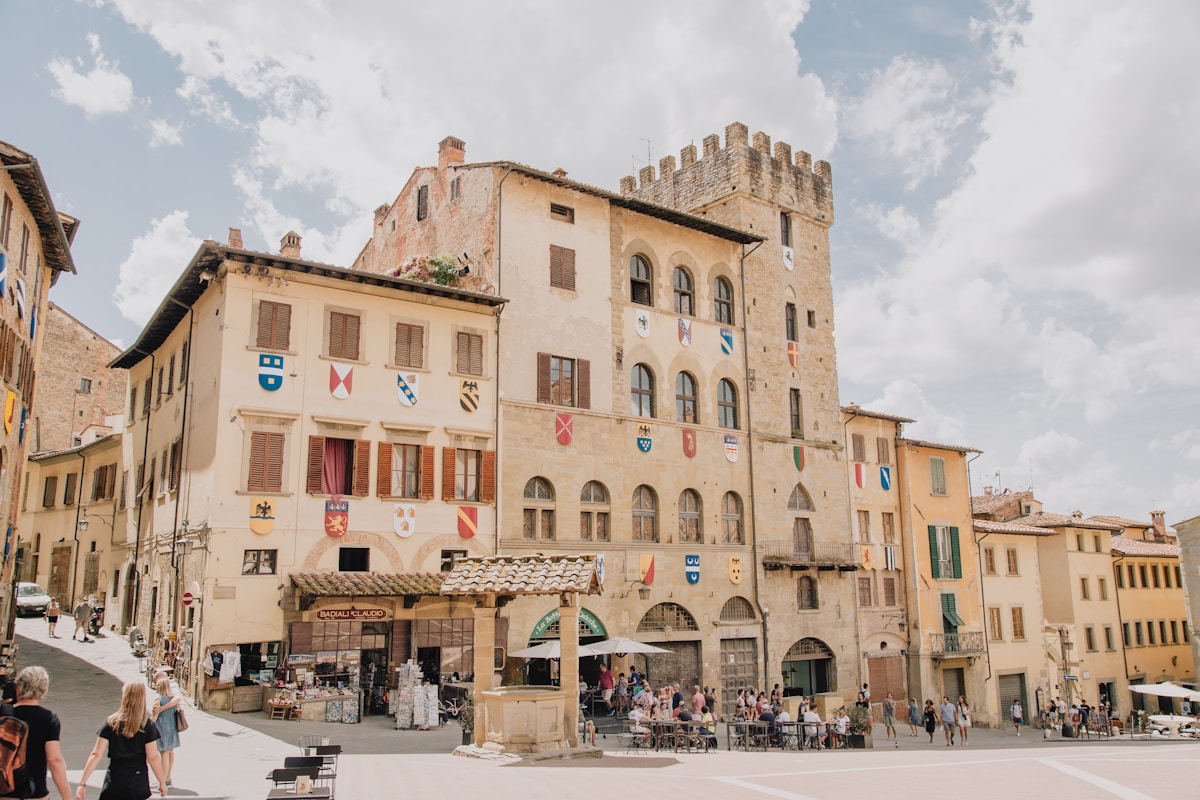
Arezzo is an undervisited Tuscan city with one of the greatest fresco cycles in Italian art, a spectacular medieval piazza that still hosts jousting tournaments, and the largest antiques market in Italy. It sits at the junction of three Tuscan valleys - the Valdarno, the Casentino, and the Valtiberina - and is the gateway to the southern Chianti, the Casentino forests, and the upper Tiber valley.
Piero della Francesca - Legend of the True Cross
The single most important reason to come to Arezzo. The Basilica of San Francesco in the centre of the town contains Piero della Francesca’s fresco cycle The Legend of the True Cross (1452–1466) in the apse chapel. This is one of the supreme works of 15th-century Italian painting - ten scenes depicting the legendary history of the wood from which the True Cross was made, from the Tree of Life in the Garden of Eden through to the Battle of Milvian Bridge (Constantine’s victory).
Piero’s style is distinctive and immediately recognisable: geometric clarity, silent figures, extraordinary light effects, spatial organisation of almost mathematical precision. The Dream of Constantine scene - a soldier asleep in a tent, illuminated by an angel descending at night - is one of the most innovative uses of artificial light in pre-Renaissance painting.
Visits are timed and limited - book online at pierodellafrancesca.it. A maximum of 25 people at a time, for 30 minutes. €12 entry. Do not come to Arezzo expecting to enter without a booking.
Piazza Grande
The main square of Arezzo is built on a slope, creating a theatrical space framed by the apse of Santa Maria della Pieve (Romanesque church), the Palazzo della Fraternita dei Laici (Gothic/Renaissance), the Palazzo del Tribunale, and the Logge Vasari (designed by Giorgio Vasari, 1573). An exceptionally coherent ensemble. Giorgio Vasari was born in Arezzo; the Casa Vasari (now a museum with his own frescoes) is nearby.
The Piazza Grande is the site of the Giostra del Saracino - the Joust of the Saracen, a medieval jousting tournament held on the first Sunday of September and the third Saturday of June. Four quarters of the city (quartieri) compete; lancers on horseback charge at a wooden figure (the Saracen king) and attempt to hit a target while avoiding being struck by the rotating arm the figure swings on impact. One of the most authentic medieval tournaments in Italy; not a tourist reconstruction but a genuine civic competition.
Santa Maria della Pieve
The Romanesque church on the eastern side of the Piazza Grande has the most unusual facade in Arezzo - three tiers of colonnaded arcades, each tier different, nicknamed “the hundred columns.” The polyptych by Pietro Lorenzetti on the high altar (1320) is a significant work of the Sienese school.
The Antiques Market
Arezzo hosts one of the largest antiques fairs in Italy on the first Sunday of every month (and the preceding Saturday) in the Piazza Grande and surrounding streets. Hundreds of dealers selling furniture, prints, ceramics, silverware, and curiosities. The market began in 1968 and has grown to over 500 stalls. Serious antiques buyers arrive early (from 7am); the best pieces are gone by 10am.
The Cathedral (Cattedrale di San Donato)
A Gothic cathedral begun in the 13th century, with stained glass by Guillaume de Marcillat (the finest medieval stained glass in Italy), frescoes by Piero della Francesca (a small but significant Magdalene figure), and a Gothic tomb of Guido Tarlati (1330) - an elaborate carved narrative tomb.
Day trips from Arezzo
Cortona (30 minutes south) - a hill town that predates Rome by centuries, with significant Etruscan archaeology, the Diocesan Museum (Fra Angelico’s Annunciation), and the best view over the Chiana valley.
Sansepolcro (30 minutes east) - the birthplace of Piero della Francesca; the Museo Civico holds his Resurrection of Christ (1463), which Aldous Huxley called “the greatest painting in the world.”
Casentino forests (north of Arezzo) - the Apennine forest above Arezzo contains the Camaldoli monastery (founded 1012) and the Franciscan hermitage of La Verna (where St Francis received the stigmata in 1224).
Book Arezzo Tours on GetYourGuide
| Tour | Duration | From price | Highlights |
|---|---|---|---|
| Arezzo guided walking tour — Piazza Grande and Vasari | 2 hrs | From €25 | Piazza Grande, Vasari Loggia, historic centre with local guide |
| Piero della Francesca art tour — Legend of the True Cross | 2.5 hrs | From €40 | Timed entry to San Francesco frescoes, art-history guide |
| Arezzo and Cortona day trip from Florence | 10 hrs | From €65 | Two Tuscan hill towns, Chiana valley views, small group |
Browse all Arezzo tours on GetYourGuide →
Back to the full Arezzo travel guide for Piero della Francesca, the antiques market, and train connections. For Arezzo food, see the Arezzo food guide. For day trips from Arezzo to Cortona, Sansepolcro, and the Val d’Orcia, see day trips from Arezzo. For accommodation, see best hotels in Arezzo. Arezzo is part of the Tuscany circuit - our Tuscany itinerary includes it as a stop. For guided visits to the Piero della Francesca frescoes and the antiques market, Arezzo tours are available. For the Renaissance art context making the frescoes more rewarding, our guide to the Italian Renaissance provides the background.
Where to stay in Arezzo: Find hotels in Arezzo — search accommodation across all budgets.