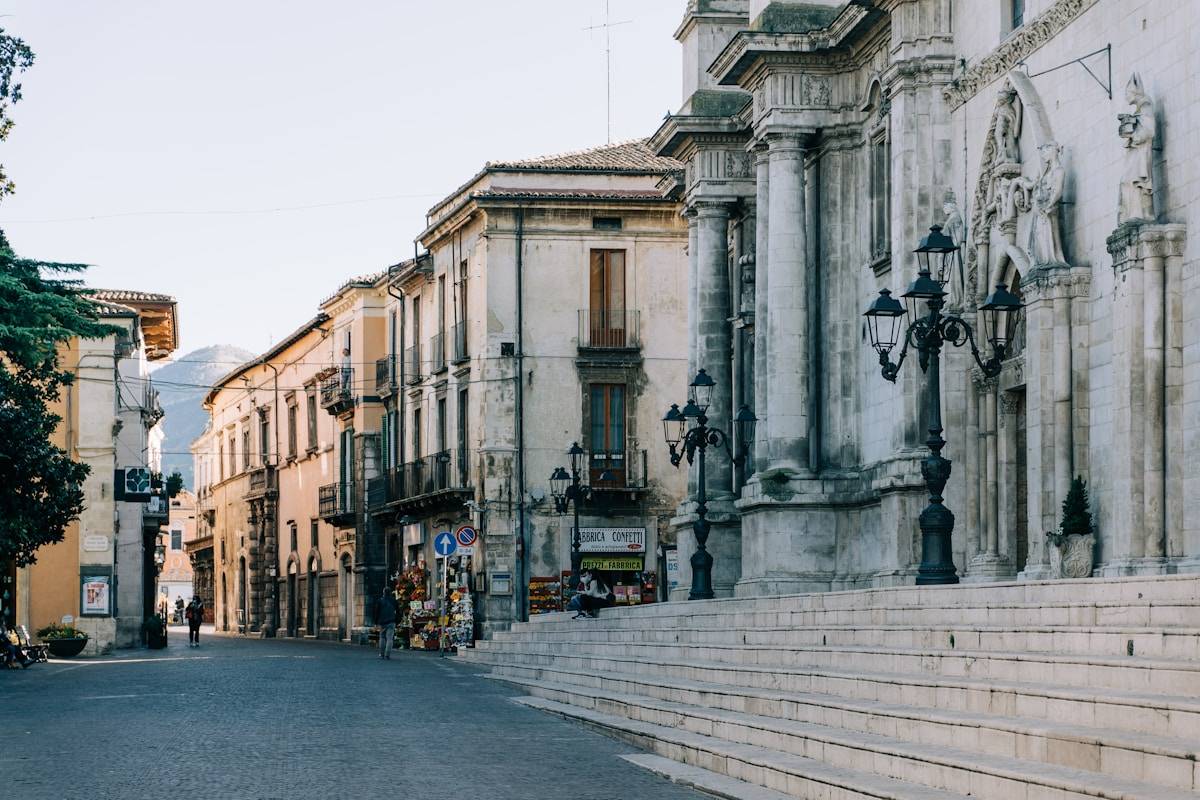
Sulmona is the most complete town in inland Abruzzo — a compact medieval and Baroque centre in the Peligna valley at around 375 metres altitude, surrounded on three sides by the Gran Sasso, Majella, and Morrone mountain ranges. It is the birthplace of Ovid, the most exported product of the Abruzzo confectionery tradition, and the most practical base for exploring the region’s mountains and national parks. Despite all of this, it receives a fraction of the visitors that comparable Umbrian towns attract.
The historic centre is walkable in a morning. The main drag, Corso Ovidio, runs roughly north–south through the town, with the principal monuments concentrated near the two main squares at either end.
Piazza Garibaldi and the Medieval Aqueduct
The Piazza Garibaldi is the largest and most impressive space in Sulmona — a long rectangular square at the southern end of the historic centre, used for markets and events. Its most distinctive feature is the medieval aqueduct that spans the western side of the square: a 13th-century structure that carried water from Monte Morrone into the town and whose arches now frame one end of the piazza in a way that is immediately recognisable and unlike anything else in central Italy. Entry to the square is free; it is always accessible.
At the corner of the aqueduct and the square stands the Church of San Francesco della Scarpa — a Gothic structure whose single nave is open for visits and contains a wooden crucifix of the 14th century.
The Annunziata Complex
The Complesso della SS. Annunziata (Corso Ovidio 58) is the most important architectural ensemble in Sulmona: a palace, church, and museum occupying the full eastern side of a small square just off the main corso. The palace facade (1415) is one of the finest late-Gothic civic buildings in the Abruzzo; the church alongside was rebuilt in Baroque style in the 18th century. The Museo Civico Diocesano inside holds local archaeological material and religious art, with some pieces from Samnite and Roman sites in the valley. Entry costs approximately €3 as of 2026; open Tuesday to Sunday 10:00–13:00 and 15:30–18:30.
Confetti Workshops and Shops
Sulmona’s confetti — sugar-coated almonds shaped and wired into flowers, bouquets, and elaborate compositions — are produced in workshops across the historic centre and sold in specialised shops along Corso Ovidio. The tradition dates to the 15th century at the latest, and the town ships its products across Italy and internationally as wedding favours and gifts.
The most established producers are Pelino (Via Stazione Introdacqua 55), which has been in operation since 1783 and offers a small museum of confetti history alongside its shop (free entry, open Monday to Saturday 09:00–13:00 and 15:30–19:30), and Mario Fratini (Corso Ovidio 183), known for unusual shapes and a wider colour range. Prices for confetti start at approximately €10–15 per 200g box and rise considerably for elaborate sculpted arrangements.
Ovid’s Birthplace
A statue of Ovid (43 BC–17/18 AD) stands in the square named after him at the northern end of Corso Ovidio. There is no museum dedicated to the poet — he left Sulmona young and is commemorated mainly through the statue and street names — but the connection is genuinely celebrated locally. If you know the Metamorphoses or the Ars Amatoria, the statue is a satisfying bookmark to visit.
Majella National Park Access
Sulmona is the most convenient entry point for the eastern and northern sections of the Majella National Park. The park covers the Majella massif — a broad, high ridge at around 2,793 metres — with deeply eroded gorges, beech forests, and more than 2,000 plant species recorded within its boundaries.
The Maielletta plateau, reached by a toll road from Abbateggio (approximately €5 for cars as of 2026), offers a network of marked trails at around 1,800 metres. The most popular walk is the ascent to Monte Amaro (2,793 m), which takes approximately 4–5 hours return from the plateau and requires no technical climbing equipment in summer — sturdy boots and a wind layer are sufficient.
The Parco Avventura Majella near Guardiagrele offers guided canyon trekking and via ferrata routes for those who want structured outdoor activities with equipment provided (from approximately €35 per person as of 2026).
Day Trips from Sulmona
Scanno — the most scenic village in the region, with Lake Scanno below — is 30 kilometres south of Sulmona by road. Buses run from Sulmona bus station approximately 3–4 times daily, taking around 50 minutes to 1 hour; fares approximately €3.50 one way as of 2026. Read our guide to Scanno and Lake Scanno for full detail.
Cocullo (20 km west of Sulmona) is unremarkable to visit on most days but holds the Festa dei Serpari on the first Thursday of May each year: a procession carrying a statue of San Domenico covered in live snakes through the village streets, a tradition that predates Christianity and draws large crowds. Buses run from Sulmona to Cocullo on the festival day.
Pescocostanzo (30 km south-east), a high-altitude village at 1,395 metres, has one of the finest Baroque main squares in the Abruzzo and a tradition of lacemaking and ironwork still visible in local workshops. Local buses from Sulmona run approximately twice daily.
Where to Stay in Sulmona
Mid-range:
- Hotel Italia (Piazza Tommasi 3) — The most central option in Sulmona, a few steps from Piazza Garibaldi. Rooms are comfortable and the breakfast good for the price. Rooms from approximately €70–110 per night.
- Palazzo Mayer (Via Circonvallazione Orientale) — A restored palazzo on the edge of the historic centre with more character than the standard hotel options. Rooms from approximately €80–130 per night.
Budget:
- B&B La Casa di Nonno Angelo (Via Fonte Tura) — A small, family-run B&B in a restored house in the centro storico. Doubles from approximately €55–75 per night.
Agriturismo:
- Agriturismo Il Vecchio Frantoio (on the Sulmona–Scanno road) — Working farm producing olive oil, with simple but comfortable rooms and a fixed menu of farm cooking in the evenings. Rooms from approximately €60–85 per night, dinner approximately €20–25 per person extra.
Where to Eat in Sulmona
Abruzzese cooking in Sulmona is built around the local lamb, spit-roast meats, mountain cheeses, and pasta — particularly maccheroni alla chitarra (square-section egg pasta cut on a wire frame, or chitarra) served with lamb or pork ragù.
- Ristorante Italia (Piazza XX Settembre 24) — The most reliable option for traditional Abruzzese cooking: chitarra with lamb, roast lamb with rosemary, grilled sausages with pecorino. Approximately €25–40 per person.
- Trattoria La Pecora Nera (Via Branconio 26) — Smaller, less formal, with a short menu that changes weekly and an unusually good selection of local wines. Approximately €20–35 per person.
- Il Gatto e la Volpe (Corso Ovidio 136) — A useful lunch stop: arrosticini (skewered lamb skewers, a regional staple), bruschette with local olive oil, and a daily pasta. Approximately €12–20 per person at lunch.
- Confetteria Pelino café (Via Stazione Introdacqua 55) — Not a restaurant but a café adjacent to the historic confetti factory, serving coffee, pastries, and confetti liqueur in a period interior.
Arrosticini — thin skewers of castrated mutton grilled over a long charcoal trough — are the one thing to eat in Abruzzo that has no real equivalent elsewhere. Most trattorias and street stalls serve them; expect to eat eight to ten on a typical order, at approximately €10–15 for a portion.
Getting There and Around
- By train: The Sulmona railway station (Piazza della Stazione) has connections to Pescara (approximately 1 hour 20 minutes) and to L’Aquila via Avezzano (approximately 1.5 hours). Change at Pescara for Rome. Fares on regional trains from approximately €7–15 one way as of 2026.
- By bus: ARPA buses from Sulmona reach Scanno, Pescocostanzo, and Pescasseroli (for the national park). The bus station is adjacent to the railway station.
- By car: Sulmona is on the A25 motorway, 1 hour 40 minutes from Rome via the A24/A25. Parking is available at Piazza della Stazione and on the ring road around the historic centre; most of the centre itself is restricted.
Book Abruzzo Tours on GetYourGuide
| Tour | Duration | From price | Highlights |
|---|---|---|---|
| Sulmona historic centre guided walking tour — confetti, Ovidio, and medieval streets | 2 hrs | From €20 | Piazza Garibaldi, Complesso della SS. Annunziata, Pelino confetti factory |
| Abruzzo national park day trip from Sulmona — bear and wolf territory | 6 hrs | From €50 | Parco Nazionale d’Abruzzo, Civitella Alfedena wildlife area, Apennine scenery |
| Abruzzo food experience — arrosticini, chitarra pasta, and local wine | 3 hrs | From €45 | Lamb skewers, maccheroni alla chitarra, Montepulciano d’Abruzzo tasting |
Browse all Abruzzo tours on GetYourGuide →
For the Abruzzo circuit from Sulmona — Scanno lake (30 km south via Sagittario gorge), the Parco Nazionale d’Abruzzo (40 km south), and Pescocostanzo (30 km southeast) — car hire in Italy gives the flexibility that ARPA buses can’t match for the mountain villages. For a southern Italy itinerary with Abruzzo as a detour from Rome, our southern Italy itinerary provides the broader context. L’Aquila is the Abruzzo regional capital, 1 hour northwest by bus — it has one of the finest medieval city centres in central Italy, partially rebuilt after the 2009 earthquake.